Guides
Choosing a cut flower sales channel strategy that fits farm capacity
Cut flower sales channel strategy guide covering channel fit, customer promises, labor, delivery, waste, pricing, capacity, records, and seasonal review.
What to take away
- Choose a sales channel by its full workload, timing, risk, and buyer promise, not its headline price.
- Match crop mix, harvest volume, design skill, delivery capacity, and customer contact to the outlet.
- Define grades, units, order deadlines, pickup or delivery terms, and payment before the first sale.
- Measure revenue, unsold product, labor, travel, fees, and credits by channel.
- Start with a small channel test and expand only after the farm can deliver reliably.
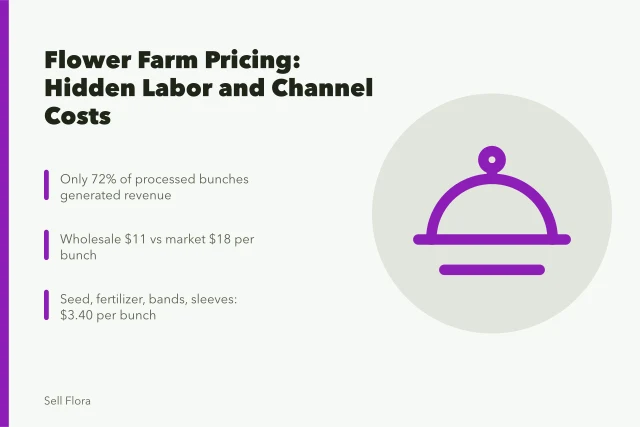
A sales channel is the complete route from a harvest-ready stem to a paid order. The route may include grading, bunching, bouquet design, photography, order entry, packing, travel, setup, customer service, invoicing, and waste. A high retail price can disappear under those costs. A lower wholesale price can work when volume is predictable and handling is simple.
The best outlet is therefore farm specific. A one-acre grower near a busy neighborhood market faces different options from a rural farm with a cooler, a delivery van, and several florist accounts. Build the decision from real capacity and buyer needs.
Start with the product and promise
Write down what the buyer receives. Ten florist-grade stems delivered in water is a different product from a wrapped mixed bouquet collected at a farm stand. A subscription is also different from a one-time preorder because it includes a schedule and repeated service.
Define:
Define the buyer promise
- Stem count, bunch, bouquet, or share
- Grade, stem length, maturity, variation
- Packaging and hydration method
- Order cutoff and confirmation method
- Pickup window or delivery day
- Minimum order, substitution, credit, payment
- Person responsible for each handoff
Do not promise exact colors or cultivars when field supply cannot support them. Offer a clearly described seasonal choice instead.
Map the main channel families
Farmers markets and farm stands
Direct retail offers immediate customer feedback and control over presentation. It also adds booth or site time, display materials, payment processing, weather exposure, and unsold inventory. The grower must enjoy customer contact or assign someone who does.
Channel families at a glance
Direct retail
- Selling style
- Booth time
- Main demand
- Customer contact
- Key risk
- Weather, unsold stock
- Customer contact
- Immediate feedback
Preorders
- Selling style
- Advance commitments
- Main demand
- Dependable calendar
- Key risk
- Missed pickups, weather
- Customer contact
- Scheduled service
Florists/events
- Selling style
- Professional repeat
- Main demand
- Accurate availability
- Key risk
- Deadline mismatch
- Customer contact
- Buyer relationship
Wholesale/co-op
- Selling style
- Bulk movement
- Main demand
- Large quantities
- Key risk
- Strict grades, payment
- Customer contact
- Minimal
Preorders, subscriptions, and pickup
Preorders reduce guessing because quantities are sold before packing. Subscriptions bring advance commitments but require a dependable calendar and a clear policy for missed pickups, pauses, substitutions, and weather losses. Subscriptions depend on a dependable calendar, which is exactly what a cut flower succession calendar built from sales weeks provides.
Florists and event designers
Professional buyers may order repeatedly and take bunches rather than finished bouquets. They expect dependable quality, accurate availability, easy ordering, and delivery or pickup that fits production deadlines. Their resale margin must remain possible.
Retail shops, restaurants, and institutions
These accounts can provide repeat volume, but receiving hours, billing, insurance, packaging, display life, and payment cycles may add work. Confirm who owns product after delivery and how credits are handled.
Wholesalers and cooperatives
These routes can move larger quantities with less individual selling. Prices may be lower, and grades, packing, commission, delivery, and payment rules may be strict. A cooperative can combine supply from several farms but does not remove the need for consistent labeling and quality.
Score fit before chasing price
Use a one-to-five score for each channel. Weight factors that constrain the farm most heavily.
Score channel fit factors
- Crop fitspecies, grades, colors, units
- Volume fitpeak harvest absorption
- Timing fitharvest, design, market, delivery
- Labor fittrained selling and fulfillment hours
- Logistics fitroute, cooler, vehicle, packaging
- Cash fitpayment timing, fees, commissions
- Risk fitweather, cancellation, credit, unsold
- Relationship fitcommunication and service style
| Factor | Question |
|---|---|
| crop fit | Does the outlet buy the species, grades, colors, and units the farm produces well? |
| volume fit | Can the outlet absorb peak harvest without requiring impossible weekly consistency? |
| timing fit | Do harvest, design, market, and delivery work collide? |
| labor fit | Are enough trained hours available for selling and fulfillment? |
| logistics fit | Can the farm meet route, cooler, vehicle, and packaging needs? |
| cash fit | When is payment received, and how are fees or commissions deducted? |
| risk fit | Who carries weather, cancellation, credit, and unsold-product risk? |
| relationship fit | Does the team have the communication and service style the buyer expects? |
Reject any option that fails a nonnegotiable constraint even if its total score is high. Cornell's Dyson School formalized this kind of comparison in its Marketing Channel Assessment Tool benchmarks, which rank each outlet using a peak week of labor hours across harvest, packing, transport, and selling, plus mileage and revenue by channel.
Calculate the channel contribution
Record gross sales and subtract the costs created by selling through that outlet. Include market or platform fees, card charges, commission, design materials, route mileage, delivery labor, setup, sales time, cleanup, credits, and the cost assigned to unsold marketable flowers.
Channel contribution math
- Channel contribution = revenue - production cost - selling cost
- Also calculate per selling hour
- Also calculate per delivery or market day
- Include fees, card charges, commission, mileage, labor, setup, cleanup, credits, unsold flowers
Channel contribution = channel revenue - production cost of units sold - channel-specific selling cost
Also calculate contribution per selling hour and per delivery or market day. A channel can produce a positive seasonal total while paying poorly for the scarce Saturday or delivery hours it consumes.
Penn State Extension's direct-marketing guidance explains that direct outlets can support higher prices and customer contact while adding labor, cost, seasonality, and less efficient delivery. Its advice to research the outlet before committing production supports a trial-first approach rather than treating direct sales as automatically better.
Build a balanced channel mix
Channels should have jobs. A florist route might absorb premium straight bunches. A preorder program might take mixed seasonal product. A market might test new crops and move small lots. Do not send the same limited flowers to competing promises.
Allocate limited flowers
- Reserve standing orders first
- Protect prepaid subscriptions second
- Offer remaining stems through weekly list
- Define who can override the rule
- Record why an override happened
Avoid dependence on one outlet when a cancellation would strand the harvest. Avoid excessive diversification too. Each extra channel adds communications, packaging, pricing, and fulfillment systems.
Run a controlled test
For a new channel, specify:
- a test period;
- the crops and maximum weekly quantity;
- the service promise;
- a price and minimum order;
- the labor and mileage codes;
- success thresholds; and
- a stop condition.
Review the test only after invoices, labor, waste, and buyer feedback are complete. Expand a channel because it fits the whole operation, not because one crowded market day looked impressive.
Common questions
Which cut flower channel has the highest margin?
There is no universal winner. Margin depends on price, units sold, production cost, waste, labor, fees, travel, and fixed-resource use on that farm.
How many channels should a new farm use?
Use as few as needed to test demand without leaving the harvest exposed. One primary outlet and one limited backup often teach more than several poorly served outlets.
Should every channel carry the same products?
No. Match grades, units, packaging, and crops to the buyer. Keep allocation rules clear when two channels want the same limited stems.
When should a channel be dropped?
Drop or redesign it when repeated records show weak contribution, poor fit, unreliable payment, excessive waste, or a workload that damages stronger channels.