Guides
Part of Costing to price, a step-by-step guide for cut flower enterprises
Turning cut flower costs into a defensible per-stem price
Calculate cut flower cost and price step by step from units sold, variable costs, labor, overhead, channel fees, break-even volume, target margin, and scenarios.
What to take away
- Use one crop, one product unit, one channel, and one time period per calculation.
- Convert harvest records into expected units sold after culls and unsold loss.
- Include paid, owner, and family labor at an explicit hourly cost.
- Allocate overhead with a documented driver such as bed use, cooler days, miles, or labor.
- Run low-volume and high-cost scenarios before publishing a price.
This worked method uses a fictional ten-stem zinnia bunch sold wholesale. Replace every number with farm records. The point is the order of calculation, not the result.
1. Define the product and period
Example enterprise:
Define the product and period
- crop
- one zinnia cultivar group;
- system
- 400 bed feet in open field;
- period
- one production season;
- sales channel
- florist wholesale route;
- unit
- one bunch of ten saleable stems.
Do not mix market bouquets into this unit. Their foliage, design labor, wrapping, selling time, and price structure differ.
2. Estimate units sold
Assume the planting produces 5,600 cut stems.
Estimate units sold
| Adjustment | Stems |
|---|---|
| total cut | 5,600 |
| field and grading culls | -700 |
| handling loss and credits | -100 |
| marketable stems not sold | -300 |
| stems sold | 4,500 |
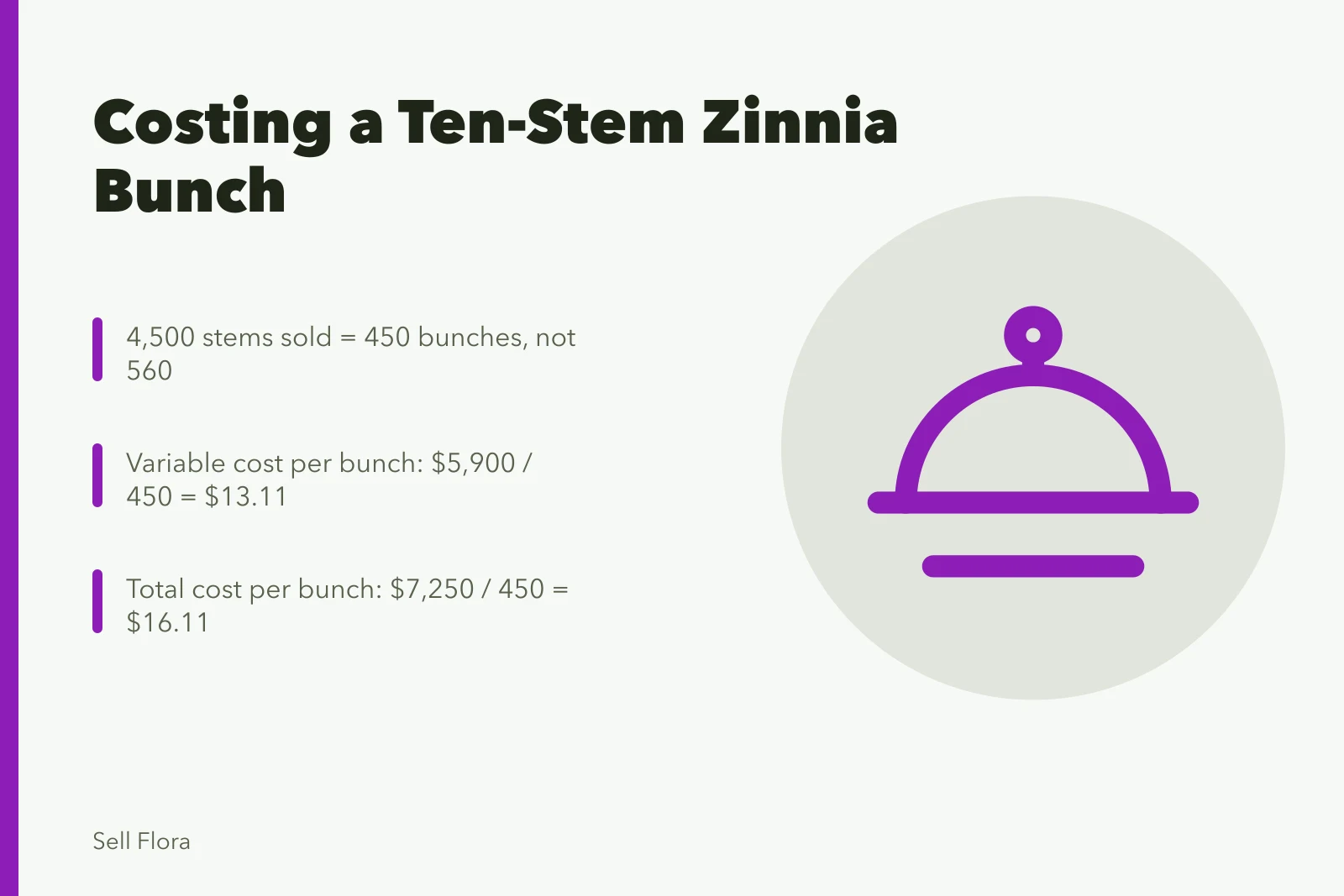
At ten stems per bunch, expected sales equal 450 bunches. Use 450 as the denominator, not 560 bunches from total cut stems.
3. Total variable costs
Fictional example:
Total variable costs
| Variable item | Cost |
|---|---|
| seed and propagation | $310 |
| fertility, soil testing, and crop inputs | $420 |
| annual mulch, labels, bands, and sleeves | $365 |
| hired and owner production labor | $2,480 |
| harvest and bunching labor | $1,620 |
| route delivery cost | $540 |
| payment and account cost | $165 |
| total variable cost | $5,900 |
Variable cost per sold bunch is $5,900 / 450, or $13.11.
Penn State Extension's enterprise-budgeting guide advises producers to include realistic receipts, operating costs, labor, and ownership costs. It also notes that not all production is sold and that completed-season actuals should be compared with the budget.
4. Allocate fixed costs
Assume documented allocations for land, cooler, equipment ownership, insurance, administration, and management total $1,350 for this enterprise.
Total Cost per Sold Bunch
- $5,900variable costs
- $1,350fixed allocations
- $7,250total enterprise cost
- $16.11total cost per sold bunch
Total enterprise cost = $5,900 + $1,350 = $7,250
Total cost per sold bunch = $7,250 / 450 = $16.11
Write down each allocation driver. For example, cooler ownership could be assigned by occupied bucket days, while general administration could use revenue share.
5. Add the required return
Suppose the farm wants a 20 percent operating margin on the selling price after the included costs.
Margin Math: Cost vs Price
Cost-plus 20%
- Formula
- $16.11 x 1.20
- Price
- $19.33
- Margin on price
- 16.7%
Target 20% margin
- Formula
- $16.11 / 0.80
- Price
- $20.14
- Margin on price
- 20%
Price = cost / (1 - target margin)
Price = $16.11 / 0.80 = $20.14
Rounding to $20.25 or $20.50 may fit the sales unit, but test the margin after rounding. Adding 20 percent to cost gives $19.33, a 16.7 percent margin on the selling price, not 20 percent.
Cornell's Small Farms Program fact sheet on profit, equity, and labor value argues the same from the whole-farm side. A return must cover interest on the farm's equity, plus the value of the operator's labor and management, not solely cash bills.
6. Check break-even volume
At a tentative $20.50 price:
Contribution per bunch = $20.50 - $13.11 = $7.39
Break-even bunches = $1,350 / $7.39 = 183 bunches, rounded up
This answers how many sold bunches cover the allocated fixed cost after their variable cost. It does not prove that 183 bunches are sufficient for the farm's overall cash needs.
7. Run scenarios
Run scenarios
Bunches sold
- weak sell-through
- 350
- expected
- 450
- strong volume
- 520
Variable cost
- weak sell-through
- $5,650
- expected
- $5,900
- strong volume
- $6,250
Fixed allocation
- weak sell-through
- $1,350
- expected
- $1,350
- strong volume
- $1,350
Cost per bunch
- weak sell-through
- $20.00
- expected
- $16.11
- strong volume
- $14.62
Do not hold variable cost constant if extra volume requires more harvest, packaging, or delivery labor. Note capacity steps, such as a second route day or cooler rental.
8. Compare with the market
Ask whether florists value the cultivar, color, stem length, consistency, bunch unit, and delivery. Compare alternatives available during the same week. If the required price is not accepted, inspect the enterprise rather than hiding labor.
Possible changes include a standing-order discount supported by lower selling loss, a five-stem premium bunch, different bed density, reduced route radius, or dropping the crop.
9. Close with actuals
At season end replace every estimate. Record actual marketable stems, bunches sold, realized price, cull reason, labor by task, delivery miles, credits, and overhead use. Preserve the original budget for comparison.
Common questions
Why use units sold instead of units produced?
Only sold units generate revenue. Culls and unsold flowers still consume resources and must be reflected in the cost of what sells.
What hourly rate should be used for owner labor?
Use a realistic rate for the work and local labor market, including applicable employment costs. State the assumption and test alternatives.
Can fixed costs be ignored in seasonal pricing?
Short-run decisions sometimes focus on variable cost, but long-run prices must support ownership and replacement costs as well as operations.
Should sales tax be included in price?
Follow current state and local rules and accounting advice. Whether tax is added or included, keep it separate from farm revenue in the calculation.