Maintenance
Part of Cut flower crop selection and production guide, updated for 2027
A crop card checklist for running a fair cut flower variety trial
Cut flower crop card checklist for cultivar identity, scheduling, propagation, spacing, support, inputs, harvest, postharvest tests, yield, labor, and sales.
What to take away
- Give each crop and cultivar a stable code from stock receipt through final sale.
- Separate planned values from actual dates, inputs, labor, and marketable yield.
- Record culls by reason so production limits can be corrected.
- Use the same harvest and vase-test standards across a comparison.
- Approve expansion only after timing, quality, labor, and sales are reviewed together.
This checklist turns crop-specific knowledge into a repeatable farm record. Complete the planning section before stock arrives, update the operating section during production, and close the card after the last sale. Use one card per cultivar, planting date, and production system when those factors are being compared.
Identity and purpose
- Farm crop code
- Botanical and common name
- Cultivar and series
- Supplier and stock lot
- Seed, plug, cutting, bulb, corm, tuber, division, or bare root
- Intended buyer and channel
- Product rolefocal, spike, filler, foliage, dried, or woody
- Required color, form, stem, bunch, and delivery window
- Current standard crop used for comparison
Schedule
- Order deadline and expected arrival
- Pretreatment or cold requirement
- Planned and actual sowing date
- Planned and actual transplant date
- Planned direct-seed date
- Pinch, prune, or disbud date
- Expected and actual first marketable cut
- Peak weeks and final useful cut
- Bed-clear date
Record weather and protected-structure status with each milestone. Days after sowing alone cannot explain a shift caused by temperature or light.
Cut Flower Trial Schedule
- Order deadlineexpected arrival
- Pretreatmentcold requirement
- Planned and actualsowing date
- Planned and actualtransplant date
- Pinch, prune, disbuddate
- First marketable cutexpected and actual
- Peak weeksfinal useful cut
- Bed-clear daterecord weather
Site and establishment
- Field, tunnel, greenhouse, or container unit
- Block, bed, and row
- Soil test reference
- Bed width and length
- Rows per bed and in-row spacing
- Planned and surviving plants
- Irrigation layout and measured output
- Mulch, support, and cover system
- Neighboring crops and prior crop
Utah State University Extension publishes regional marketable stem-yield ranges for several cut flower crops, while warning that climate, soil, water, cultivar, and management change results. Put outside benchmarks in a separate field from the farm's actual marketable yield.
Site and Establishment Records
- Field, tunnel, greenhouse, or container unit
- Block, bed, and row
- Soil test reference
- Bed width and length
- Rows per bed and in-row spacing
- Planned and surviving plants
- Irrigation layout and measured output
- Mulch, support, and cover system
Propagation and planting
- Seed or propagule count started
- Germination or rooting percentage
- Temperature and light set points
- Cell or container size
- Loss and cull reasons
- Plant age and root condition at setting
- Hardening procedure
- Planting labor minutes
Crop operations
- Pinch, prune, or disbud rule and plant stage
- Support installation and adjustment dates
- Irrigation decision method
- Fertility products, rates, and reasons
- Weed-control method and labor
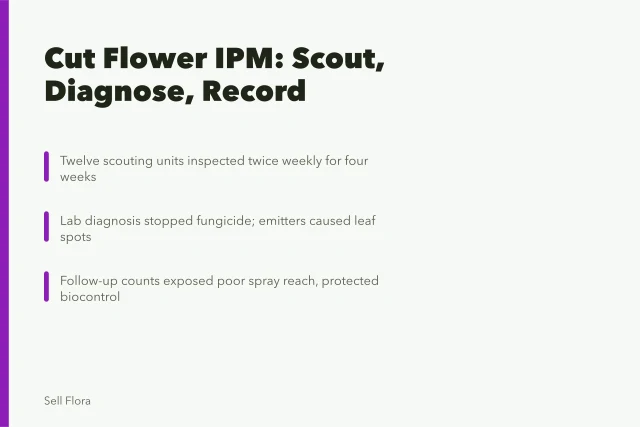
- Diagnostic submissions and results
- Pest-management actions and follow-up
- Weather or equipment injury
Harvest standard
- Approved maturity stage with photograph
- Minimum and target stem length
- Stem-strength test where relevant
- Accepted bloom diameter or spike development
- Foliage requirement
- Cut position and regrowth rule
- Harvest time and maximum field-to-shade interval
- Bunch count or sales unit
- Crop-specific handling warnings
Postharvest trial
- Clean container and solution protocol
- Hydration or treatment lot
- Cooler entry and product temperature
- Packing and transport simulation
- Standard vase environment
- Number of stems per treatment
- Days to opening and unacceptable quality
- Failure reason and photograph
Keep an untreated or current-practice control. Do not compare two changes at once unless the trial is designed to separate them.
Yield and labor
- Total stems cut
- Marketable stems
- Cullsshort, bent, immature, overmature, insect, disease, weather, handling
- Marketable stems per plant
- Marketable stems per bed foot and bed week
- Harvest minutes
- Processing and bunching minutes
- Cleanup and disposal minutes
- Total crop-specific labor hours
The national trial programs run by NC State University and the Association of Specialty Cut Flower Growers evaluate new cut flower cultivars at dozens of sites and publish production and marketing information on each entry. That breadth is a useful model because no single yield number captures production and buyer fit.
Sales and review
- Units offered, sold, donated, and discarded
- Posted and realized price
- Channel fees and delivery cost
- Buyer quality comments
- Returns or credits
- Crop-specific input cost
- Contribution per bed week and labor hour
- Repeat, modify, expand, or discontinue decision
- Reason and next trial question
Common questions
Why use separate cards for planting dates?
Temperature, light, disease, and market demand change across the season. Combining plantings can hide a failed or successful window.
Should total blooms be recorded?
Yes, if practical, but keep marketable stems separate. Revenue comes from stems that meet the sale specification and find a buyer.
How large should a crop trial be?
Large enough to include repeated units and normal farm handling without risking important space or orders. Keep a current standard beside it.
When can a trial crop expand?
After it meets the required delivery window, quality, labor, vase, cull, and sales standards over conditions representative of the intended scale.