Maintenance
Part of 6 pointers on cut flower pest that hold up
9 cut flower ipm checks before signing off
Cut flower IPM checklist for clean stock, scouting routes, pest identification, action points, control selection, pesticide labels, follow-up, and records.
What to take away
- Complete the prevention and map sections before planting.
- Define scouting units, counting methods, and action points for priority crop-pest pairs.
- Keep diagnosis, treatment approval, application, and follow-up as separate recorded steps.
- Read the current pesticide label at every use, even when the product was used before.
- Close each incident with a result and a prevention change for the next crop.
Use this checklist as an operating record, not as proof that every crop needs the same response. Add regional rules, Worker Protection Standard duties, licensing requirements, and diagnostic contacts before the season. Assign a name and due date to each incomplete item.
Before planting
- Review prior pest, disease, weed, and crop-injury records by location.
- List the priority crop-pest pairs for the coming season.
- Select resistant or tolerant cultivars where suitable options exist.
- Approve suppliers and incoming-stock inspection rules.
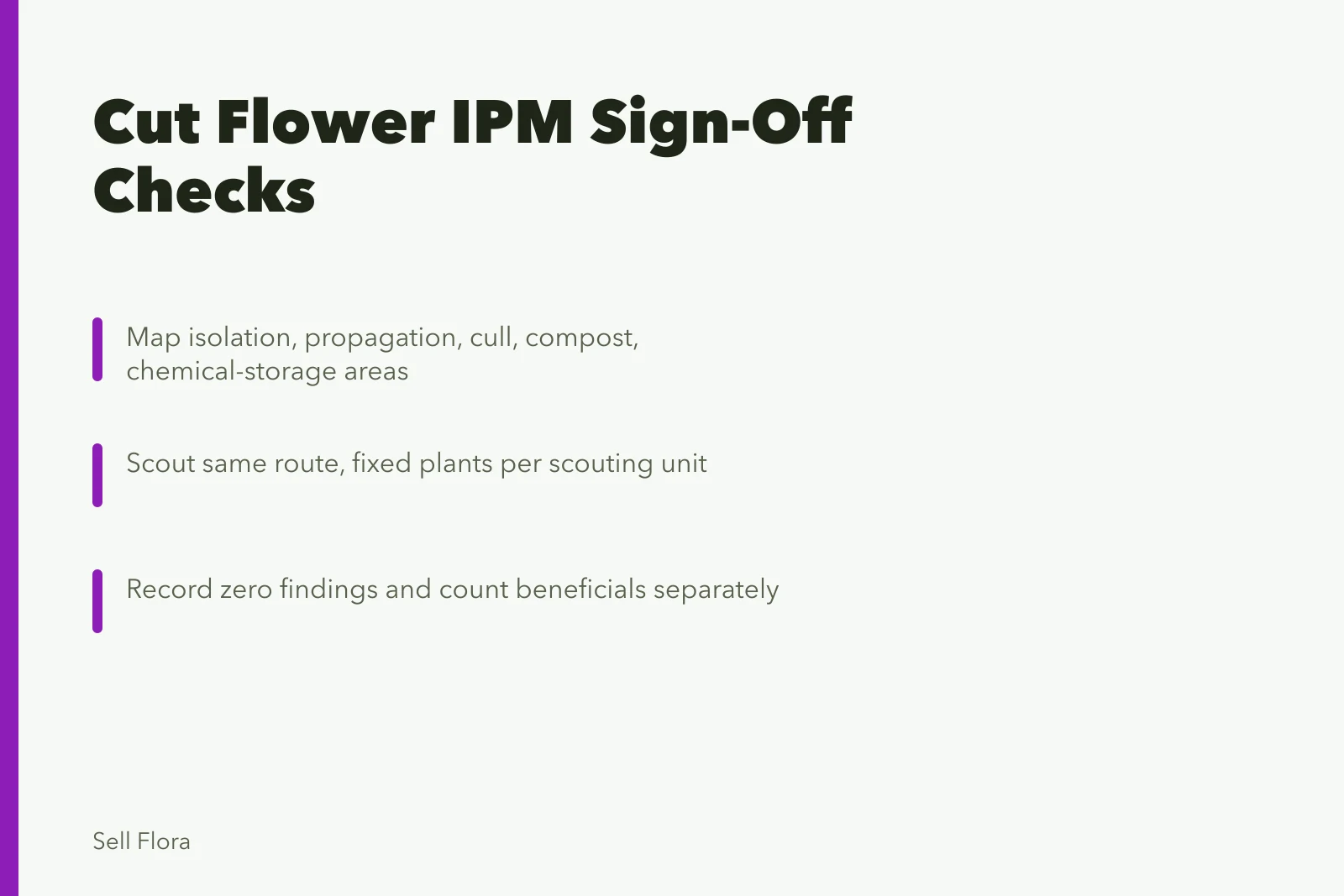
- Map isolation, propagation, production, cull, compost, and chemical-storage areas.
- Correct drainage, irrigation leaks, weeds, algae, debris, and damaged screening.
- Set cleaning procedures for trays, tools, stakes, containers, and harvest equipment.
- Plan mature spacing and access for scouting and treatment.
At crop arrival or emergence
- Record supplier, lot, crop, cultivar, quantity, and arrival date.
- Inspect roots, crowns, stems, leaves, growing tips, and flowers as applicable.
- Tap representative tender growth over white paper for small insects.
- Photograph and isolate suspect material.
- Keep incoming stock separate for the farm's defined observation period.
- Reject, treat, or release the lot under a written decision.
Weekly scouting setup
- Assign a trained scout and backup.
- Follow the mapped route in the same direction.
- Inspect field edges, doors, vents, low spots, stressed plants, and prior hot spots.
- Use a fixed number of plants or plant parts per scouting unit.
- Record zero findings as well as detections.
- Count beneficial insects separately from pests.
- Replace and count monitoring cards on a fixed interval.
- Flag hot spots and untreated comparison plants.
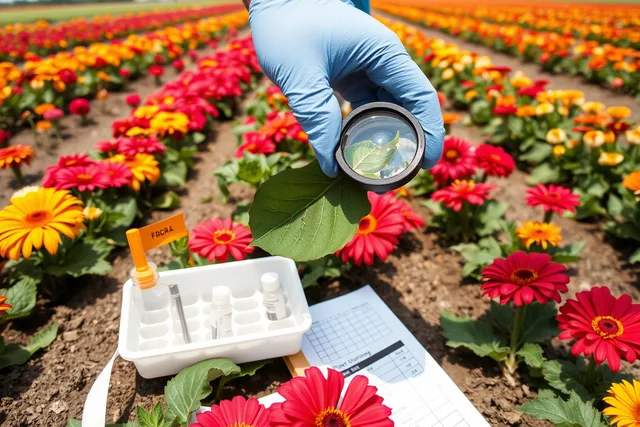
UMass Extension's field-grown cut flower guidance lists direct observation, weekly sticky-trap checks in protected production, tapping foliage over white paper, and sweep nets among methods for early insect and mite detection. Choose methods by pest and setting, not every tool everywhere.
A mapped route, fixed sample counts, and written symptom records keep a scouting program consistent week to week.
Finding record
- Date and scout name
- Block, row, or greenhouse section
- Crop, cultivar, planting date, and growth stage
- Plant part and sample size
- Pest, beneficial, sign, or symptom observed
- Count, percentage affected, and severity grade
- Distribution pattern and hot-spot dimensions
- Whole-crop, whole-plant, and close photographs
- Weather, irrigation, and recent treatment history
- Sample code and laboratory destination, if used
Before deciding on control
- Confirm the identification or record that laboratory confirmation is pending.
- Separate living pests from cast skins, old damage, and harmless organisms.
- Compare the count with the crop-specific action point.
- Consider harvest date, buyer tolerance, disease-vector risk, and spread rate.
- Review sanitation, irrigation, airflow, fertility, weeds, and stock source.
- Check physical removal, exclusion, and containment options.
- Check biological-control timing and pesticide compatibility.
- Preserve a comparison group where practical.
Before any pesticide application
- Obtain and read the current label for the exact product and formulation.
- Confirm the production site, crop, target, and application method.
- Confirm rate, water volume, timing, and maximum applications.
- Check personal protective equipment and handler requirements.
- Post and communicate the restricted-entry interval.
- Check cutting, harvest, display, or sale restrictions where present.
- Review pollinator, drift, temperature, runoff, and water protections.
- Record the resistance group and prior groups used on the target population.
- Check tank-mix and biological-agent compatibility.
- Calibrate equipment and document the calculation.
EPA explains that a pesticide label defines where, how, how much, and how often a product may be used. Do not let an old farm note, distributor summary, or online recommendation replace the current label.
Application record
- Date, start and stop time, and exact treated area
- Product name, EPA registration number, lot, and amount
- Active ingredient and resistance group
- Target and crop stage
- Applicator and license information where required
- Equipment, nozzle, pressure, speed, and carrier volume
- Weather and protected-structure conditions
- Reentry time and worker notification
- Any spill, exposure, drift, or equipment problem
Follow-up
- Set the recheck date before closing the task.
- Recount the same sampling unit and flagged hot spots.
- Inspect for new damage rather than expecting old injury to disappear.
- Record beneficial survival and crop injury.
- Compare treated and untreated areas where available.
- Decide whether to stop, continue monitoring, or choose another compatible step.
- Record the measured result and cost.
End-of-crop review
- Graph priority pest counts by week and block.
- Compare rejected stems, labor, treatment cost, and saleable yield.
- Identify recurring entry points and environmental patterns.
- Retire ineffective routines and damaged reusable materials.
- Update supplier, cultivar, sanitation, and scouting decisions.
- Archive labels, applications, laboratory reports, and incident records.
Common questions
Must every checklist item be completed every week?
No. The preplant, arrival, weekly, application, and closeout sections apply at different stages. Mark nonapplicable items and explain unusual omissions.
Can the same action point be used for every flower?
No. Market tolerance, crop stage, pest biology, vector risk, and crop value differ. Build points from regional evidence and farm records.
Why record zero pest counts?
Zeros show the start, absence, and distribution of a population. They make later trends more interpretable.
How long should records be kept?
Follow federal, state, tribal, certification, insurance, and buyer requirements. Keep operational records long enough to compare seasons and investigate complaints.