Guides
Costing to price, a step-by-step guide for cut flower enterprises
Cut flower costing and pricing guide covering enterprise units, marketable yield, labor, variable and fixed costs, channel fees, shrink, margin, and review.
What to take away
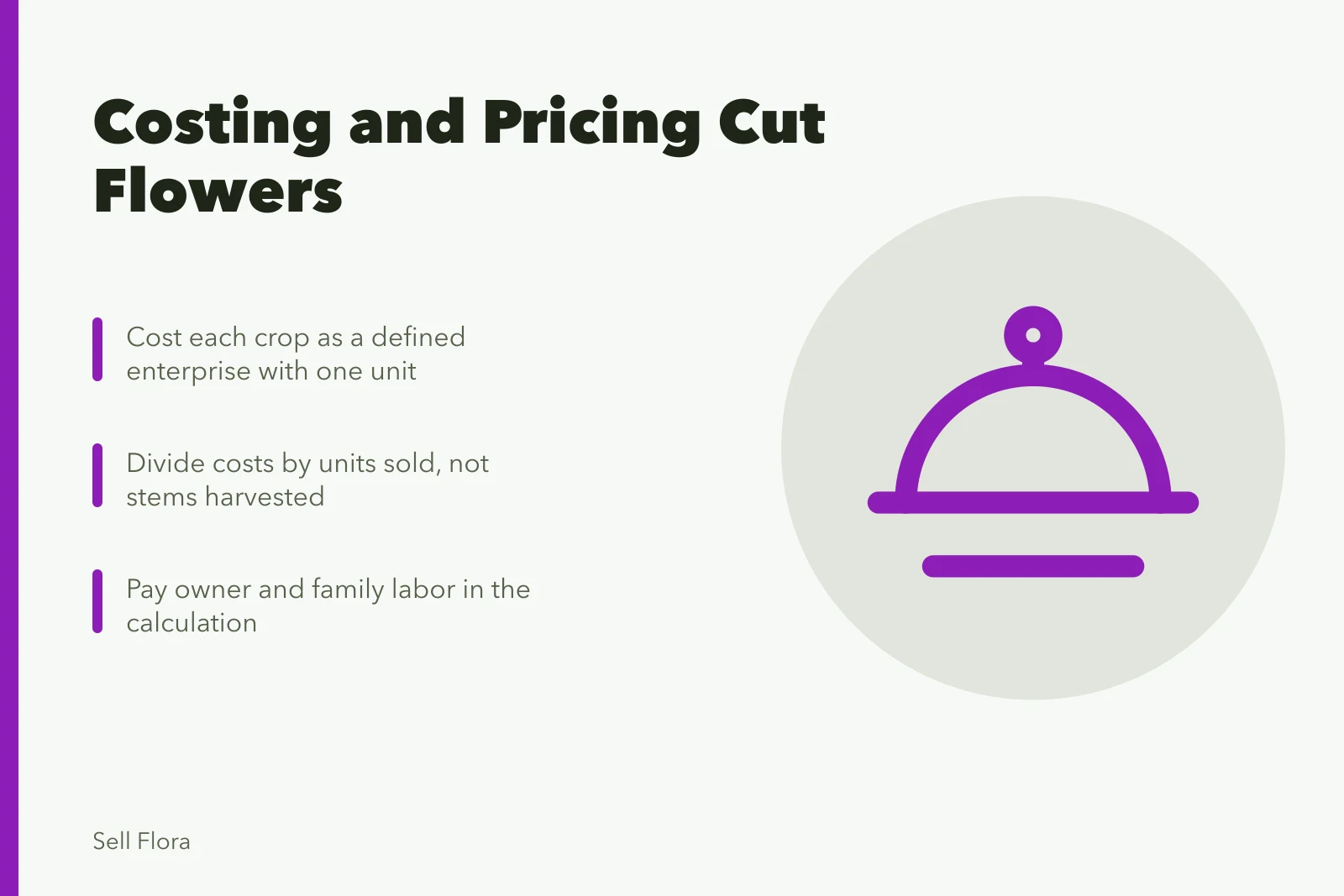
- Cost each crop or product as a defined enterprise with a consistent unit and period.
- Divide costs by units sold, not total stems harvested.
- Pay for owner and family labor in the calculation even when cash does not leave the farm.
- Separate production cost from channel, delivery, design, and selling cost.
- Test price against buyer demand, capacity, and required profit, then update it with actual records.
Price does three jobs. It covers the product's share of costs, supports the farm's financial target, and communicates an offer that a specific buyer will accept. A neighbor's bunch price cannot answer those questions because their yield, labor, overhead, channel, and product may differ.
Build the calculation from a unit the farm can measure. Examples include one marketable stem, a ten-stem bunch, one farmers market bouquet, one subscription share, or one florist delivery order. Keep unlike products separate before combining them into a whole-farm view.
Choose the enterprise and denominator
Define crop, cultivar group if relevant, production system, field area, and season. A tunnel snapdragon crop and field snapdragon crop should not share one budget if their structure, timing, yield, and labor differ.
Tunnel vs Field Snapdragons
Tunnel crop
- Structure
- protected
- Timing
- earlier
- Yield
- higher
- Labor
- tunnel tasks
- Budget
- separate
Field crop
- Structure
- open field
- Timing
- seasonal
- Yield
- weather-limited
- Labor
- field tasks
- Budget
- separate
Useful denominators include:
- planted bed foot for spatial comparison;
- bed week for crops with different occupation time;
- marketable stem for wholesale cuts;
- finished bunch or bouquet for direct sales; and
- labor hour for capacity decisions.
Use more than one denominator when the farm has two limiting resources.
Estimate saleable output
Start with plants established and marketable stems per plant or bed foot. Subtract field culls, processing culls, storage loss, rejected orders, donations, and unsold product. Keep each reason visible.
From Stems to Sold Units
- Plants established
- Marketable stems per plant
- Subtract field culls
- Subtract processing culls
- Subtract storage loss
- Subtract rejected orders
- Subtract donations and unsold
Units sold = marketable units produced - unsold and lost marketable units
Do not price against the best trial yield. Use a defensible expected range, then run poor, expected, and strong scenarios.
List variable costs
Variable costs change with the enterprise's scale or output. For flowers they may include:
Variable Cost Checklist
- Seed, plugs, bulbs, tubers, cuttings
- Compost, fertilizer, crop protection, testing
- Mulch, netting, labels, bands, sleeves
- Propagation, planting, weeding, scouting labor
- Harvesting and processing labor
- Market fees, commissions, card fees, packaging
- Delivery mileage and hired delivery labor
Track quantities and purchase prices. A total credit-card charge without the crop allocation cannot support next year's decision.
Allocate fixed costs
Fixed or ownership costs continue even when a specific stem is not produced. They can include land occupancy, cooler and building depreciation, insurance, licenses, bookkeeping, office expense, salaried management, and equipment ownership.
Fixed Cost Allocation Methods
Cost
- Cooler cost
- occupied cubic-foot days
- Delivery vehicle
- route miles
- Farm administration
- revenue or labor
- Land occupancy
- consistent method
- Insurance/licenses
- consistent method
Allocation basis
- Cooler cost
- Delivery vehicle
- Farm administration
- Land occupancy
- Insurance/licenses
Choose an allocation method that reflects use. Cooler cost might follow occupied cubic-foot days. Delivery-vehicle ownership might follow route miles. General farm administration might follow revenue, labor, or a consistent combined method. Document the choice so it is not changed to favor one crop.
University of Maryland Extension's enterprise budget guidance stresses sales quantity, shrinkage, labor, variable costs, and allocated fixed costs. It also warns that receipts should reflect product sold rather than total production. That distinction is critical for perishable flowers.
Calculate break-even and required price
Basic calculations:
| Measure | Formula |
|---|---|
| variable cost per sold unit | total variable costs / units sold |
| total cost per sold unit | variable plus allocated fixed costs / units sold |
| contribution per unit | selling price - variable cost per unit |
| break-even units | fixed costs / contribution per unit |
| margin on selling price | (price - cost) / price |
Add a planned return for risk, reinvestment, and profit above total cost. Do not confuse markup on cost with margin on selling price.
Add channel cost
The same stem can have different finished costs by channel. Wholesale may need bunching, availability lists, delivery, and account administration. A farmers market bouquet adds design labor, wrapping, booth fee, transport, setup, selling time, and unsold inventory. A subscription adds customer service and pickup logistics.
Price the product sold in that channel, not a naked stem that never reaches the customer alone.
Test demand without abandoning cost
Compare the required price with buyer interviews, past sell-through, competitive alternatives, and product differences.
Cornell's Small Farms Program warns in its guide to pricing farm products that copying nearby farms' prices without analyzing your costs can leave an operation unprofitable. The cost floor comes first.
If the market will not cover total cost, options include improving marketable yield, reducing labor, changing the unit, or changing channel. Also consider raising perceived usefulness, limiting the crop, or stopping it.
Lower price is not the only response. A smaller bouquet, tighter delivery area, standing order, seasonal premium crop, or reduced color list may improve the system.
Review actual versus budget
Close each crop with actual yield, units sold, realized price, labor, channel fees, culls, and fixed-cost use. Explain the largest differences. Update the next budget with repeated evidence, not one unusual year.
Common questions
Should owner labor be included?
Yes. Assign a realistic labor cost so the enterprise is not profitable only because the owner works without compensation.
Is break-even price the selling price?
No. Break-even covers the included costs at the expected sales volume. The selling price also needs a return and must fit market and channel conditions.
How should unsold flowers be treated?
Record their production and disposal cost, but divide revenue and relevant unit costs by the units sold. Track unsold reasons separately.
Can one overhead percentage be used for every crop?
Only if it reasonably reflects resource use. Crops differ in cooler space, machinery, structure, delivery, and management burden.