Guides
Cut flower income per acre: what Midwest growers actually report
Midwest cut flower income per acre varies widely: direct-market growers report $12,000 to $38,000 gross and $3,000 to $12,000 net, with labor the largest cost.
What to take away
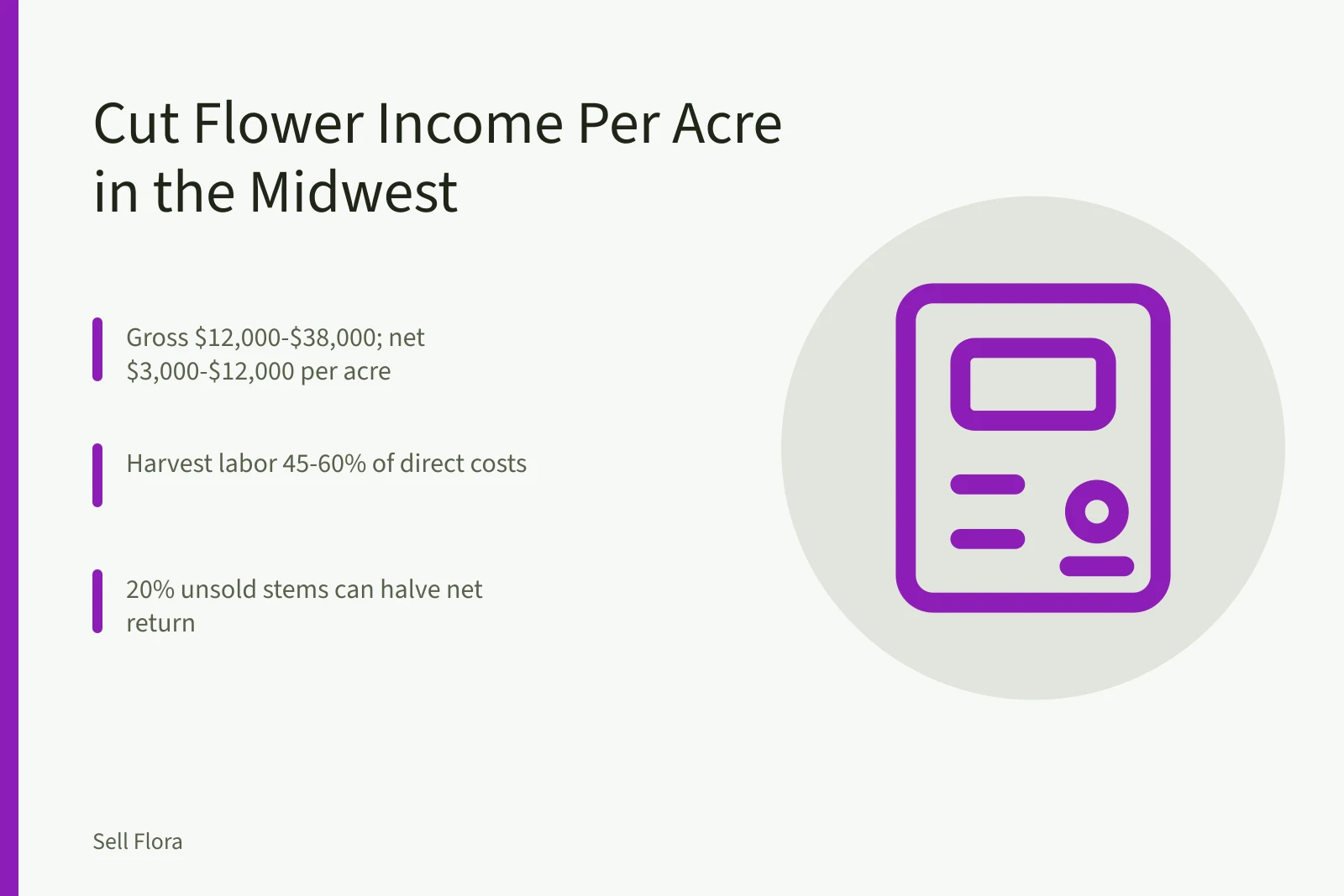
- Gross income per acre for a mixed annual and perennial Midwest cut flower planting runs roughly $12,000 to $38,000, with net cash return commonly $3,000 to $12,000.
- Iowa, Illinois, and Ohio growers usually report lower land rent than coastal flower regions but higher season-extension and heating cost.
- Harvest and bunching labor is the largest controllable cash outlay, often 45 to 60 percent of total direct costs.
- Market channel sets the margin: farmers market stems return more per stem but carry booth fees and unsold loss.
- Moving from a quarter-acre to a full-acre batch layout cuts harvest labor cost per stem by roughly 25 percent.
What the figure covers
A per-acre income figure is gross sales minus direct cash costs for one acre over 12 months. The USDA Census of Agriculture collects floriculture sales by farm, but it does not publish per-acre revenue by county or by state in a form you can drop into a Midwest budget.
Because USDA hardiness zones set the first-frost dates in Iowa, Illinois, and Ohio, the length of the selling season directly scales gross revenue. For these states, treat the range below as a planning benchmark rather than a guaranteed return. The gross side depends on species mix, market channel, and whether you sell stems, bunches, or subscriptions.
Line by line
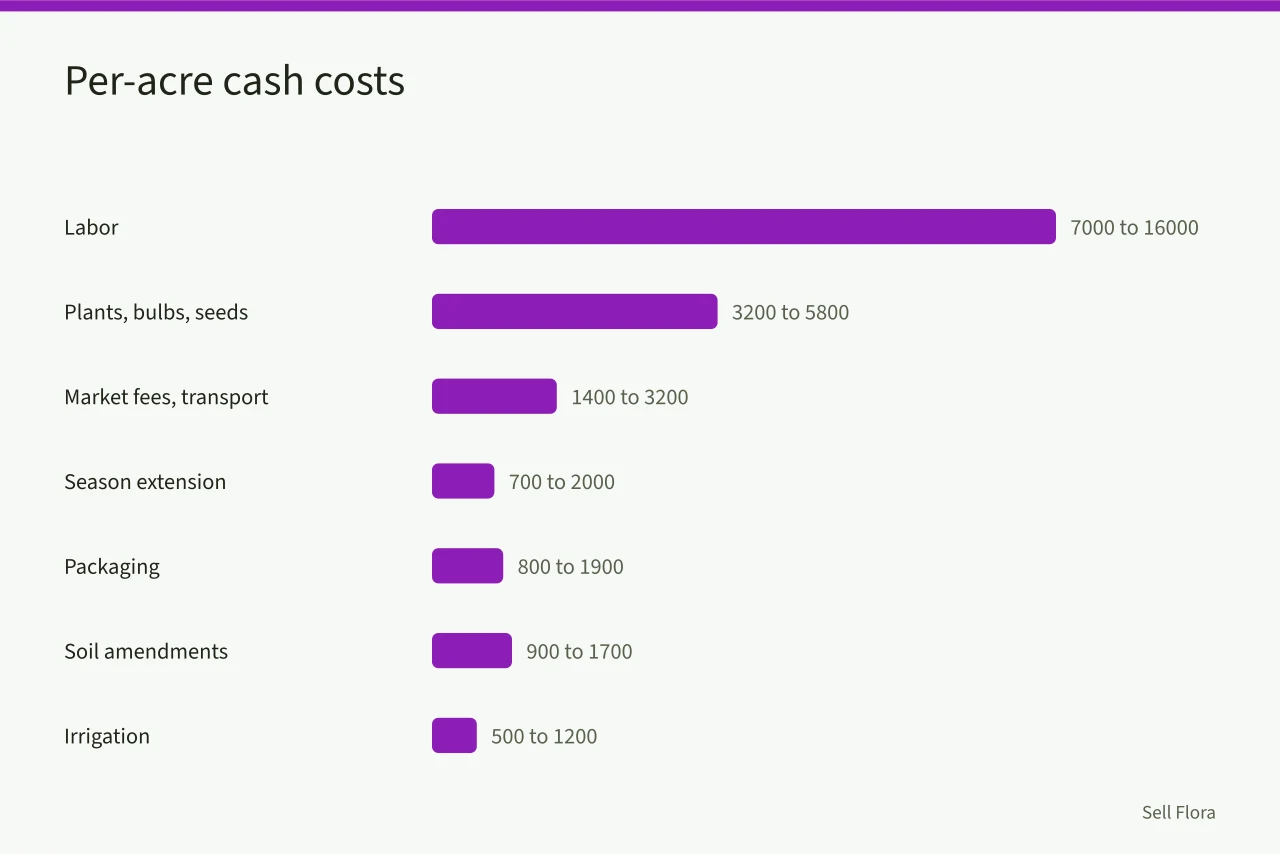
Purdue Extension's cut flower production budget, ID-436-W, lists labor, plants, and transportation as the largest cash line items for an acre of annuals. Midwest growers also pay for season extension techniques such as low tunnels and row cover, which shift sales into higher-priced weeks but add $700 to $2,000 per acre. The table below uses the same categories with illustrative Midwest ranges for a direct-market planting.
Show the numbers
| Plants, bulbs, and seeds | 3,200–5,800 |
|---|---|
| Soil amendments and compost | 900–1,700 |
| Irrigation and water | 500–1,200 |
| Season extension (low tunnels, row cover) | 700–2,000 |
| Labor for planting, harvest, bunching | 7,000–16,000 |
| Market fees, stall rent, transportation | 1,400–3,200 |
| Packaging, sleeves, rubber bands | 800–1,900 |
| Land charge or cash rent equivalent | 300–700 |
| Total cash outlay | 14,800–32,500 |
The $14,800 to $32,500 total is cash outlay before owner labor and income taxes. On a $20,000 gross acre, a $15,000 cash outlay leaves $5,000 for owner time, equipment replacement, and profit. On a $35,000 gross acre, a $19,000 outlay leaves $16,000, but that higher gross usually means more unsold stems and more market days.
Pest and disease pressure that is not caught early raises the plant and seed line, which is why growers who scout a cut flower planting early often hold more of the gross revenue.
What scale changes
Batch size changes harvest labor more than seed cost. A 1,000-stem harvest from a quarter-acre bed often takes five labor hours. At a $20 hourly wage, that is $100, or $0.10 per stem. The same 1,000 stems from a full-acre bed with fewer walk-backs takes about 3.75 hours, or $75, a 25 percent lower labor cost per stem. This is why two half-acre plots can cost more to harvest than one full acre.
What is easy to forget
Unsold stems are a cash cost, not a yield problem. A Saturday market with 20 percent unsold bunches on a $25,000 gross acre removes $5,000 before seed and labor for those stems are paid. Fuel, ice, and market stall fees often add $1,200 to $2,500 per season but get buried under transportation.

The most common planning error is pricing off gross revenue instead of net cash after unsold stems. A 20 percent unsold rate can cut a Midwest acre from a $12,000 net return to $6,000.
For tax purposes, these costs are deductible on IRS Schedule F, but the deduction timing depends on inventory accounting, not just cash spent.
Where the margin actually goes
After direct costs, the remaining gross pays owner labor, debt service, and next season's bulbs. On a Midwest acre grossing $28,000 with $15,000 in cash outlay, $13,000 is left for owner draws and equipment replacement. Growers who sell mostly at farmers markets often keep more gross revenue but spend it on booth rent, fuel, and ice every week.
On the same acre, a wholesale shift to local florists may trim market fees by $2,000 but add $1,500 in cooler storage and delivery labor. The margin does not disappear; it moves from the Saturday stall to the Wednesday delivery route. Midwest growers who track both channels often find that the profitable choice changes by month, not by year.
Common questions
What is a realistic cut flower income per acre in the Midwest? A mixed annual and perennial acre sold mostly at farmers markets and to local florists can gross $12,000 to $38,000, with net cash returns typically $3,000 to $12,000. USDA data does not publish per-acre revenue by state, so use these as planning ranges, not guarantees.
How much does harvest labor cost per stem in Iowa, Illinois, or Ohio? For a direct-market crew paid $18 to $22 per hour, harvest and bunching labor usually runs $0.08 to $0.15 per stem for annuals, depending on stem length and bed layout. This is before owner labor, which is often unpaid in the first two years.
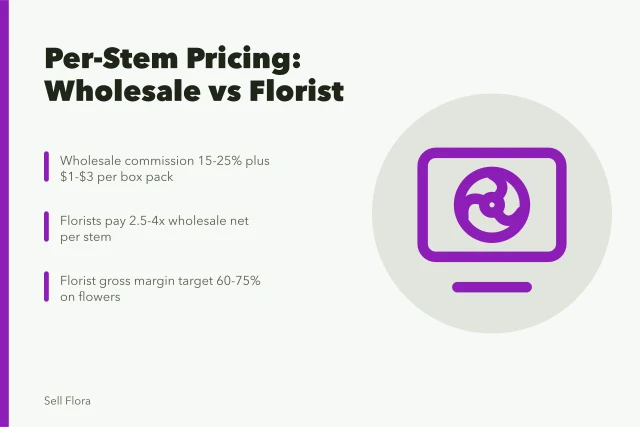
How do direct-to-florist sales change the margin? Direct sales to florists often cut stall fees but add cooler storage and delivery cost. A costed example with numbers appears in wholesale versus florist sales.
Why is net income so much lower than gross income per acre? Seed and plant costs are small; harvest labor, market fees, transportation, and unsold stems consume most of the gap. A 20 percent unsold rate on a $25,000 gross acre removes $5,000 before those stems' production costs are counted.