Maintenance
Part of Costing to price, a step-by-step guide for cut flower enterprises
Running a records-and-pricing checklist that keeps a flower business honest
Cut flower business checklist for sales, receipts, crop costs, labor, inventory, equipment, channels, delivery, culls, budgets, pricing approvals, and backups.
What to take away
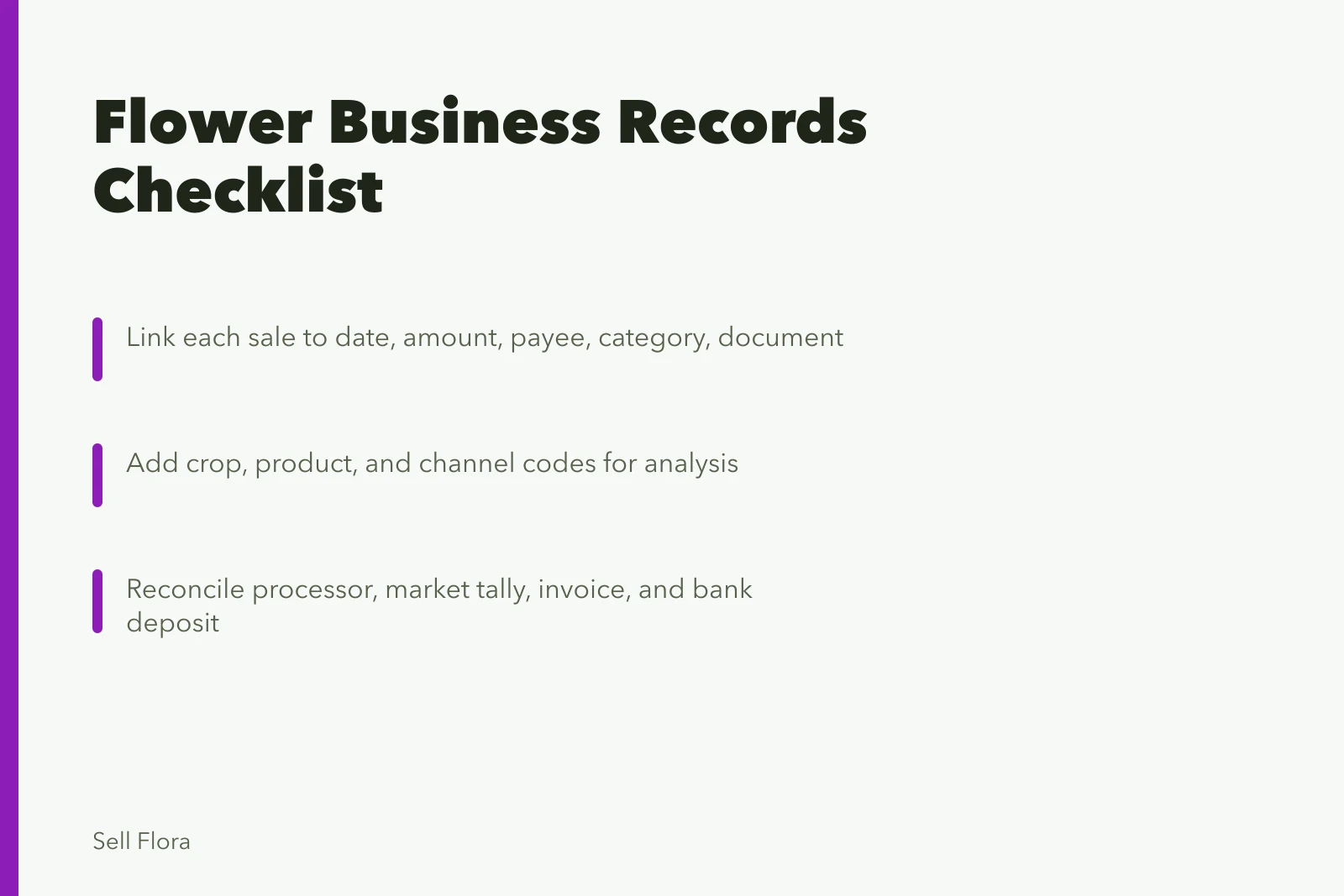
- Connect every transaction to a date, amount, source or payee, category, and supporting document.
- Add crop, product, and channel codes needed for management analysis.
- Reconcile financial records with production, inventory, labor, and sales units.
- Keep tax records and management records related but not interchangeable.
- Assign backup, access, retention, and review responsibilities before the season.
This checklist supports enterprise analysis and pricing. It does not replace advice from a qualified accountant, attorney, payroll provider, insurer, or tax authority. Add current federal, state, tribal, and local requirements for the farm.
Record system setup
- Select accounting method with professional advice.
- Create a chart of accounts that separates useful income and expense categories.
- Create crop, field, product, customer, outlet, and channel codes.
- Separate business and personal bank and payment activity.
- Assign who records, approves, reconciles, backs up, and reviews entries.
- Document corrections rather than overwriting unexplained history.
- Test that digital records and attachments can be retrieved and read.
- Set retention rules by record type and legal requirement.
Sales records
- Sale date and invoice or transaction number
- Customer, outlet, and channel
- Product, crop, grade, quantity, and unit
- Listed price, discount, delivery fee, and tax treatment
- Gross sale, payment fee, refund, credit, and net receipt
- Payment method and deposit date
- Order date, delivery date, and fulfillment status
- Unsold, donated, returned, and discarded units
Reconcile payment processor, market tally, invoice, and bank deposit. A weekly total without product units cannot explain whether price, volume, or mix changed.
Purchase and expense records
- Vendor, date, invoice, receipt, and payment proof
- Item, quantity, unit cost, freight, and tax
- Expense category
- Crop, product, field, or channel allocation
- Inventory or asset treatment reviewed
- Employee reimbursement documentation
- Subscription period and renewal date
- Credit, return, rebate, or warranty payment
Cornell's Small Farms Program notes that a farm needs records for tax and legal compliance at a minimum, and its guide to farm record keeping walks through holding sales receipts, expense receipts, and a capital asset depreciation log in an organized system. Management analysis usually needs more detail than those legal minimums.
Crop and production records
- Stock lot, crop, cultivar, planting date, and production system
- Planted and surviving units
- Bed feet and bed weeks
- Input quantities by crop
- Total and marketable stems
- Culls by reason
- Bunches or products made
- Units sold by channel
- Crop close date and cleanup cost
Labor records
- Worker and job classification
- Date, start, stop, and breaks under applicable rules
- Crop, task, and channel code
- Paid hours, owner hours, and family hours separated
- Wage, payroll taxes, benefits, workers' compensation, and other burden
- Mileage, reimbursement, and approved expenses
- Training, safety, and restricted-entry records where required
Use short task codes workers can apply in the field. A complex system that is not used produces false precision.
Inventory and assets
- Seed, bulbs, tubers, supplies, packaging, and chemicals received and used
- Lot, quantity, cost, storage location, and expiration where relevant
- Equipment purchase date, basis, location, condition, and disposal
- Cooler, tunnel, irrigation, vehicle, and tool ownership records
- Repair and maintenance by asset
- Insurance schedule and serial numbers
Channel costs
- Market, cooperative, or platform fee
- Commission and card-processing cost
- Packaging and display supplies
- Sales, setup, and teardown labor
- Delivery miles, vehicle time, and route labor
- Customer service and invoicing time
- Refunds, credits, and bad debt
- Unsold loss by outlet
University of Minnesota Extension's direct-marketing guide emphasizes using current enterprise costs, channel access, local comparisons, and the farm's own records when evaluating price and market choice. Keep outlet and channel separate so one strong market does not hide a weak one.
Monthly close
- Reconcile bank, card, processor, cash, and loan accounts.
- Match deposits with invoices and sales reports.
- Attach missing receipts and explain unmatched items.
- Review accounts receivable and credits.
- Update inventory and asset purchases.
- Compare actual cash flow with projection.
- Review crop and channel labor completeness.
- Back up records and test one recovery.
Price review
- Update units sold, culls, and unsold loss.
- Update labor rates and task time.
- Update stock, packaging, fuel, fee, and delivery cost.
- Review overhead allocation drivers.
- Calculate contribution and break-even volume.
- Compare buyer feedback and truly comparable offers.
- Approve price, effective date, and communication plan.
Year-end close
- Reconcile production units with sales and remaining inventory.
- Replace crop budgets with actual results.
- Review enterprise, channel, and whole-farm performance.
- Count assets and supplies under the accounting method.
- Archive contracts, payroll, taxes, insurance, licenses, and applications.
- Confirm retention and secure disposal schedules.
- Give the tax professional organized supporting documents.
- Record next season's pricing and production questions.
Common questions
Is a bank statement enough proof of a business expense?
It may show payment, but the farm should also retain the invoice, receipt, or other evidence showing the business purpose and item purchased.
Should every minute be tracked by crop?
Track enough detail to answer management questions without making the system unusable. Sample difficult shared tasks and document allocation methods.
Are tax categories sufficient for crop pricing?
Usually not. Tax reporting may combine costs that management needs by crop, product, task, outlet, or channel.
How often should prices be reviewed?
At least before each sales season and after closing a crop, plus whenever major costs, channel terms, quality, or volume change.