Reviews
Part of Costing to price, a step-by-step guide for cut flower enterprises
Break-even, cost-plus, and value pricing methods compared for flower farms
Cut flower pricing methods compared across break-even, cost-plus, target return, competitor, customer-value, channel, volume, premium, and delivered pricing.
What to take away
- Break-even pricing finds a floor for the costs and volume included in the model.
- Cost-plus and target-margin pricing require correct formulas and complete cost records.
- Competitor pricing describes another seller's offer, not the farm's cost.
- Customer-value pricing depends on evidence about quality, timing, scarcity, service, and alternatives.
- The final method must account for channel cost, sell-through, capacity, and long-run return.
No pricing method removes judgment. The useful approach combines a cost floor with market evidence and a financial target. The table below separates what each method answers and what it can miss.
Method comparison
Main question
- break-even
- what price covers stated costs at expected sales?
- cost-plus
- what price adds a set return to cost?
- target margin
- what selling price produces a stated margin?
- competitor based
- what do comparable sellers charge?
- customer value
- what is the offer worth to this buyer?
- channel based
- what must this route or outlet recover?
- volume
- what concession is supported by lower selling cost or firm commitment?
- premium
- what higher price fits a scarce or superior specification?
Useful when
- break-even
- testing viability and minimum volume
- cost-plus
- costs and units sold are reliable
- target margin
- the farm manages by gross or operating margin
- competitor based
- checking local alternatives
- customer value
- timing, rarity, service, or quality differs
- channel based
- wholesale, market, subscription, and event costs differ
- volume
- standing orders reduce loss and admin
- premium
- evidence shows a meaningful difference
Main risk
- break-even
- mistaken for a profitable target
- cost-plus
- incomplete cost or wrong markup formula
- target margin
- demand may not support the result
- competitor based
- copies another business's costs and quality
- customer value
- unsupported assumptions about willingness to pay
- channel based
- inconsistent pricing without clear service differences
- volume
- discount exceeds the saved cost
- premium
- premium label without repeatable quality
Break-even and cost-plus
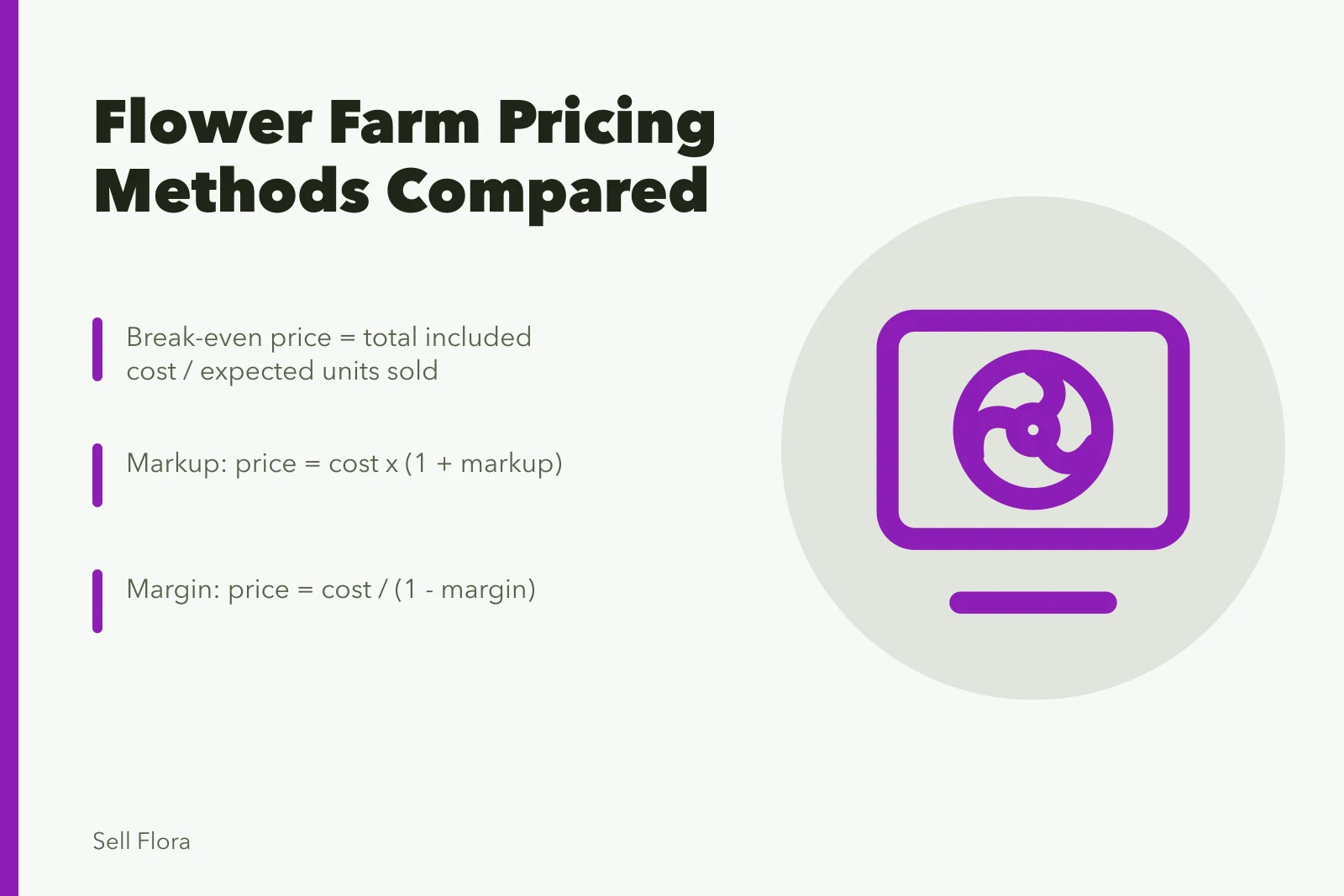
Break-even price is total included cost divided by expected units sold. It changes when volume, culls, labor, or overhead allocation changes. A crop can appear viable at 600 bunches and fail at 350.
Cost-plus adds a planned return. Be clear whether the farm adds a markup to cost or targets a margin on selling price:
Markup vs Margin Formulas
Markup
- Formula
- price = cost x (1 + markup)
- Base
- cost
- Result
- adds return to cost
Margin
- Formula
- price = cost / (1 - margin)
- Base
- selling price
- Result
- targets margin on price
Penn State Extension's retail farm pricing discussion explains cost-plus pricing, markup, margin, competition, and price changes. It notes that price must serve the marketing and financial plan, not merely match a nearby seller.
Target return
Target-return pricing includes a desired return on capital, management, or another business resource. It is useful when a crop requires expensive tubers, a heated structure, or cooler capacity that could serve another enterprise.
State the base and period. A 15 percent return on annual sales is not the same as 15 percent on invested capital. Ask an accountant to review treatment of depreciation, interest, taxes, and owner compensation.
Competitor pricing
Collect prices only from comparable offers:
- same crop, grade, stem length, and maturity;
- same bunch count or finished bouquet size;
- same week and geographic market;
- same wholesale or retail channel; and
- similar delivery, terms, and consistency.
A supermarket import, local florist retail stem, grower wholesale bunch, and farmers market bouquet are not one price series. Competitor information tests context; it does not set the farm's floor.
Customer-value pricing
Value may come from a narrow local season, unusual form, event color, long stem, verified vase performance, dependable delivery, small order minimum, or responsive communication. Ask what the buyer substitutes when the product is unavailable and what failure costs them.
Test a proposed premium through quotes, preorders, controlled price tests, and repeat purchase. Compliments without a purchase do not prove value.
Channel and delivered pricing
Build separate channel cost layers. Wholesale delivery adds route labor and vehicle cost. Farmers markets add booth, setup, selling time, payment fees, and unsold product. Subscriptions add administration and pickup. Event work adds consultation, recipe, processing, and deadline risk.
Delivered pricing may use a zone, minimum order, route-day minimum, or separate fee. Make the policy consistent and clear.
Volume and standing-order discounts
A discount is defensible when the order reduces cost or uncertainty. A prepaid standing order may lower selling time, cull risk, and unsold inventory. Calculate those savings before setting the concession.
Break-even Unit Formula
- Fixed costs
- Divide by (price - variable cost per unit)
- Equals break-even units
- Discount lowers contribution
- Raises units required
The U.S. Small Business Administration's calculator expresses unit break-even as fixed costs divided by price minus variable cost per unit. Use the formula to see how a discount reduces contribution and raises the number of units required.
Choose a method in five passes
- Calculate variable and total cost per unit sold.
- Add the farm's required return.
- Compare truly similar offers.
- Test buyer value and channel fit.
- Run lower-volume, higher-cost, and discount scenarios.
Document the final price, assumptions, approval date, and review trigger. Review when stock, wage, packaging, fuel, fee, cull, or sales volume changes materially.
Common questions
Is competitor pricing enough for a new farm?
It provides context, but the farm still needs a provisional cost model and a plan to collect actual labor, yield, cull, and sales data.
Is a high margin always better?
Not if the price reduces total profitable sales or damages a key channel. Compare total contribution, capacity, and customer response.
Should wholesale always be half of retail?
No fixed ratio fits every product and service. Cost the product, selling work, delivery, order size, and risk in each channel.
When should prices change?
Review on a schedule and when major costs, specifications, channels, or demand shift. Communicate account changes before orders are placed.