Guides
When should Northeast growers start snapdragons for early cut flowers?
Northeast USDA zones 5-6 snapdragons need an 8-10 week indoor start for early cut flowers. Sow mid-February to mid-March and transplant under cover.
What to take away
- Northeast USDA zones 5-6 should start snapdragons indoors 8-10 weeks before the last spring frost for early cut flowers. For most of the region, that means mid-February to mid-March.
- Sow seed on the surface of moist soilless mix at 65-70°F; light triggers germination.
- Grow seedlings cool at 50-60°F, then pinch once at 3-4 true leaves to push branching stems.
- Harden off and transplant under row cover 2-3 weeks before the last frost; expect first cuts from late May into early June.
Snapdragons are cool-season annuals often started indoors 6-8 weeks before the last frost for early bloom, a window that works in milder regions. In the Northeast, zone 5-6 growers should stretch that to 8-10 weeks because February light is weak and indoor warmth can produce leggy plants.
The Northeast sowing window
For zones 5-6, the last spring frost commonly lands between April 20 and May 20, depending on elevation, distance from the coast, and cold air drainage. Coastal southern New England and the New York City area tend toward late April; inland upstate New York and northern New England may not clear frost until late May. Use the table below as a working start for an early succession.
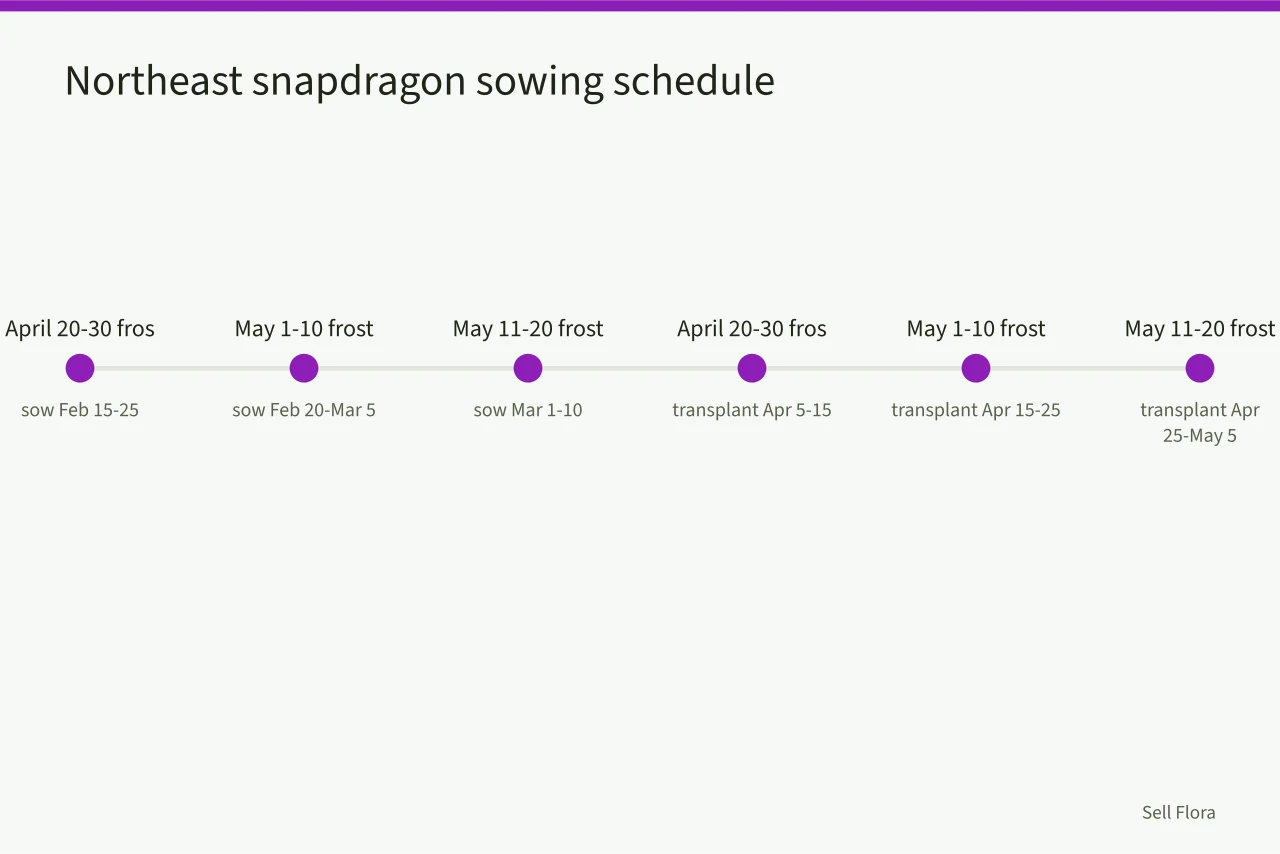
| Last spring frost window | Start snapdragons indoors | Transplant under row cover |
|---|---|---|
| April 20-30 | February 15-25 | April 5-15 |
| May 1-10 | February 20-March 5 | April 15-25 |
| May 11-20 | March 1-10 | April 25-May 5 |
These windows are illustrative, not a guarantee. Microclimates matter more than the zone number. The table is a starting range, not a fixed date, because cold pockets and south-facing fields differ even within the same town. For a fuller calendar built from your own frost dates, see USDA hardiness zones. That article explains how a first-frost map should shape every later sowing and transplant date.
What you need before starting
- 72-cell or 128-cell plug trays with drainage holes
- sterile soilless seed-starting mix
- clear humidity dome or plastic wrap
- adjustable grow lights or a bright, cool south-facing window
- seedling heat mat with thermostat
- small fan for air movement
Snapdragon seed is tiny, so use fresh seed and a firm, level surface. The fan matters once seedlings emerge; moving air reduces damping-off, a fungal collapse that can wipe out a tray overnight.
The sequence
- Count back 8-10 weeks from your expected last frost date. For an April 30 last frost, sow between February 20 and March 5.
- Fill trays with moistened mix, tap to settle, then press lightly. Sow 2-3 seeds per cell on the surface. Do not cover snapdragon seed; Snapdragons need light to germinate.
- Mist the surface, cover with a humidity dome, and set trays at 65-70°F on a heat mat. Expect emergence in 5-14 days; remove the dome as soon as the first seedlings appear.
- Move trays to bright light and cool air at 50-60°F. Once the first true leaves appear, feed with quarter-strength soluble fertilizer every third watering.
- When seedlings have 3-4 true leaves, pinch out the growing tip with small scissors or fingernails. This pushes side shoots that become cuttable stems.
- Harden off for 7-10 days, increasing outdoor exposure by an hour or two each day. Transplant 2-3 weeks before the last frost under a low tunnel or floating row cover.
Where judgement replaces the recipe
The 8-10 week count is a starting point, not a law. In a warm, bright basement with grow lights, seedlings may be ready at 7 weeks; in a cold north-facing room they may need 10. Watch the plants rather than the calendar. Regional differences in cool-season crops run deeper than frost dates. Generic nationwide advice fails because the same crop behaves differently in a mild coastal climate. The Cool-season versus warm-season divide shows why region-specific dates matter outside the Northeast.
How to tell it is right
Seedlings are ready to pinch when they show 3-4 true leaves and the stem feels firm, not soft. A measurable test: the root ball should hold together when you lift a cell, and the plant should be 3-4 inches tall after pinching. Side shoots should appear within 7-10 days if temperature stays near 50-60°F.
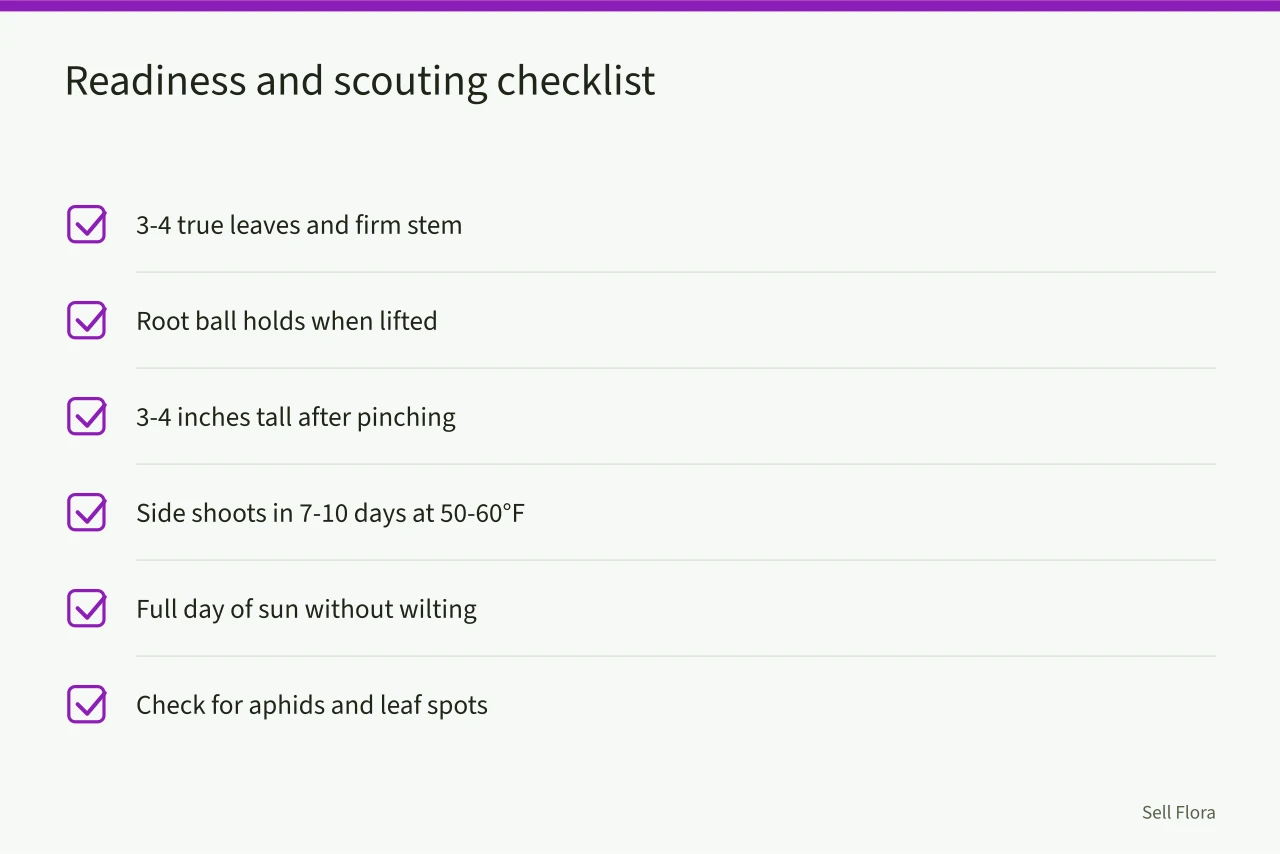
Before setting out, harden the plants until they can take a full day of sun without wilting. Walk the bed at transplant and again five days later. Look for aphids on new growth and leaf spots that spread in humid tunnels. Snapdragons under cover are vulnerable to aphids and rust in still, moist air. The same early scouting routine in scout a cut flower planting applies to snapdragons.
Fixing it when it is not
The most common failure is leggy, stretched seedlings. They come from too much heat or too little light. Do not throw them away. Pinch the stem back to just above the lowest set of true leaves, then move the tray to a bright 50-60°F spot. Within two weeks, side shoots will appear. A second common failure is damping-off, where seedlings collapse at the soil line. If you see it, remove the affected cells, increase air movement, and let the surface dry between waterings. Do not reuse the mix.
Common questions
Can I start snapdragons earlier than 8-10 weeks in zones 5-6? No. Earlier starts usually stretch and flower poorly unless you have a bright, cool greenhouse. Eight to ten weeks is the practical range.
What if my last frost date is April 15 or May 25? Adjust the table by counting back 8-10 weeks. April 15 means sow February 5-15; May 25 means sow March 10-20.
Do snapdragons need light to germinate? Yes. Press seed into the surface but do not cover it. Keep trays at 65-70°F and expect emergence in 5-14 days.
What other early cuts can I start with snapdragons? For related early spring crops, see overwinter ranunculus corms. That article covers corm storage and spring forcing dates.