Rules
Part of Cut flower nutrition, from bed history and pH to a monitoring routine
Cut flower soil problems: compaction, salts, and pH in the field
Field diagnosis of cut flower soil problems: compaction, poor drainage, soluble salts, pH, nutrient imbalance, excess compost, and surface crusting.
What to take away
- Similar leaf and growth symptoms can come from water, roots, salts, pH, or nutrients.
- Diagnose the pattern across the bed before choosing a product.
- Compaction removes pore space, while poor drainage deprives roots of oxygen.
- Soluble salts can make a wet soil behave like a drought from the plant's perspective.
- A paired sample from affected and healthy soil often clarifies a localized problem.
When a cut flower block turns pale, stunts, wilts, or produces short stems, fertilizer is only one possible answer. The first task is to identify where the problem begins, how it follows the site, and whether roots and water explain it better than leaf color does.
For a cut flower business the mistake is measured in saleable stems: a hardpan, a salt front, or an off-target pH shows up as short stems, uneven flushes and missed succession windows, not only as an ugly bed.
Use the following field sequence before treating the entire bed.
Map the pattern
Walk beyond the visibly damaged row. Mark where symptoms start and stop, whether they follow an irrigation line, wheel track, slope, former compost pile, bed edge, or cultivar. Compare planting date and crop stage.
Symptom pattern points to cause
Do symptoms follow an irrigation line, wheel track, slope, or bed edge?
suspect soil, water, equipment, or application history
check cultivar, planting date, and crop stage
A problem that follows several unrelated species may point to soil or water. A problem limited to one cultivar may reflect genetics, disease, or crop-specific sensitivity. A straight strip can reveal equipment or application history.
Compaction
Common signs: slow infiltration, shallow roots, standing water above a dense layer, poor growth in paths or wheel tracks, and soil that breaks into hard plates or clods.
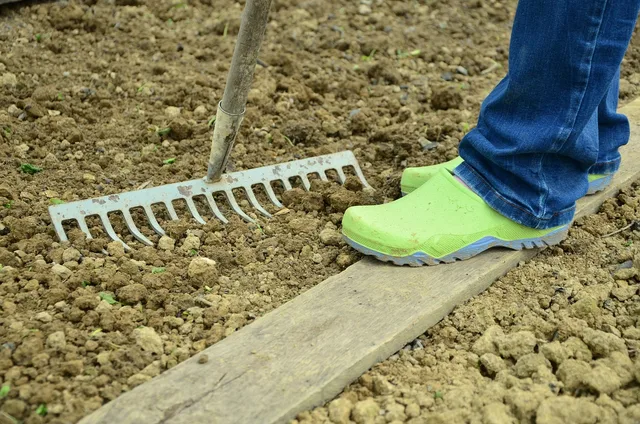
Compaction presses particles together and reduces the pores that hold and transmit air and water. Utah State University Extension's Solutions to Soil Problems IV: Soil Structure and Compaction connects repeated traffic with lost pore space and impaired root growth, drainage, water storage, and aeration.
Check: use a penetrometer, the cone-tipped gauge that reads resistance in megapascals (MPa), to compare resistance at the same moisture content in weak and healthy areas, and note the depth where resistance peaks and roots flatten. Dig a profile and look for abrupt root turns or a dense layer. A probe reading alone can mislead when one spot is much drier.
Response: stop traffic, keep workers in permanent paths, avoid tilling wet soil, and use deep-rooted crops or mechanical loosening only when conditions and the compacted depth justify them. Prevent recurrence before disrupting the layer.
Poor drainage and saturation
Common signs: water remains after rain, roots are brown or sparse, plants wilt despite wet soil, algae or crust appears, and disease increases in low zones.
Check: dig after a normal irrigation, inspect layer changes, confirm whether water enters slowly or enters but cannot leave, and evaluate the outlet. A raised bed can lift roots, but it does not create an outlet for a site that collects runoff.
Response: redirect outside water, repair grading or drainage where appropriate, reduce irrigation to actual need, protect structure, and choose a better site if the hydrology cannot support the crop.
Soluble salts
Common signs: marginal burn, stunting, poor germination, wilt despite moisture, and a crust near the surface or emitter. Salts may accumulate from fertilizer, manure, compost, irrigation water, or insufficient leaching.
High salts make it harder for roots to extract water. Utah State's Solutions to Soil Problems I: High Salinity (Soluble Salts) describes this chemical drought and recommends laboratory electrical-conductivity testing. It also explains that leaching requires both clean water and adequate drainage.
Check: test soil and, where relevant, irrigation water for electrical conductivity (EC), reported in decisiemens per meter (dS/m) or the equivalent millimhos per centimeter (mmhos/cm). Ask which method the laboratory used: a saturated paste extract and a 1:2 soil-to-water dilution produce different numbers and can only be compared with ranges published for the same method. Sample high and normal zones separately. Do not diagnose salinity from white residue alone.
Response: stop the source, improve drainage, and follow a locally calculated leaching plan. The leaching fraction is the share of applied water that must move below the root zone to push salts down; it works only where drainage carries that water away. Adding more compost or fertilizer without analysis may raise salt loading.
Unsuitable pH
Common signs: interveinal chlorosis, slow growth, or apparent deficiency despite adequate total nutrients. Symptoms vary by crop and pH direction.
Cut flower species do not share the same tolerance. Lisianthus, snapdragon, stock and sunflower can sit in the same field and respond differently to the same pH, and blocks planted to several crops often show symptoms in one row and not the next. Confirm the target range your laboratory or extension guide gives for the crop you are actually growing before correcting a whole bed.
Check: obtain laboratory pH and lime or buffer information. Laboratories report pH in water or in a dilute calcium chloride solution, and a buffer test such as the SMP or Sikora method estimates how much lime the soil needs; the method changes the number, so compare only with ranges reported for the same method. Review irrigation-water alkalinity and previous lime or sulfur. A handheld reading can help map differences but should not drive a large correction without suitable calibration and interpretation.
Response: follow the soil-test recommendation. Calcitic or dolomitic lime raises pH and elemental sulfur lowers it, and the rate depends on the buffer test result, the depth and bulk density of the soil you are treating, and the purity and particle size of the product, so the laboratory's recommendation per area beats a general rule of thumb. In calcareous soils, attempting to lower the whole bed substantially may be impractical.
Nutrient deficiency or excess
Common signs: discoloration, weak growth, delayed flowering, abnormal tissue, lodging, or excessive leaf production. Position on old versus new leaves can help, but visual keys are not definitive.
Check: review soil tests, application records, root health, and irrigation. Send a properly collected tissue sample to a laboratory that publishes sufficiency ranges by crop — many land-grant university soil and plant testing laboratories do — and follow its instructions on plant part and growth stage, because the range only applies to the specified tissue. Compare a small treatment only after identifying a likely nutrient need.
Response: apply the deficient nutrient at a crop-appropriate rate and time. Stop adding nutrients already above target. A complete fertilizer can worsen imbalance when only one element is needed.
Excess compost or manure
Common signs: very high phosphorus or potassium, rising salts, heavy vegetative growth, or repeated fertility problems despite further additions.
Check: test soil and the amendment, then reconstruct cumulative rates. Volume applied per bed is more informative than the statement that the soil receives "a little compost."
Response: stop or reduce the accumulating source, use cover crops or low-nutrient organic inputs where an organic-matter goal remains, and export nutrients through harvested biomass only as part of a measured plan.
Surface crusting and poor emergence
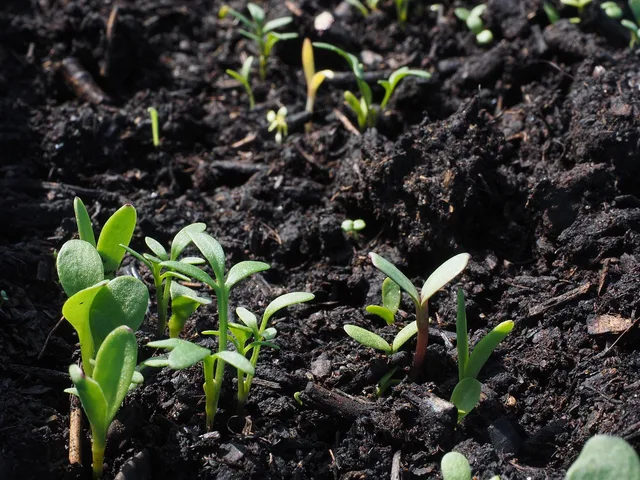
Common signs: a sealed surface, seedlings trapped below it, runoff, and uneven stands after intense rain or overhead irrigation.
Check: compare the surface under mulch or crop residue with bare ground. Look at aggregate stability and irrigation droplet impact.
Response: protect the surface, use suitable irrigation, add organic matter according to tested need, and avoid pulverizing soil into fine particles. Resow only after fixing the emergence barrier.
Common questions
Can leaf color identify a nutrient deficiency?
It can suggest possibilities, but water stress, root injury, pH, disease, herbicide exposure, and normal cultivar color can look similar. Confirm before treating.
Does gypsum fix clay soil?
Not as a universal remedy. Its benefit depends on the specific soil chemistry and problem. Use a test-based recommendation.
Should compacted soil be tilled deeply?
Only when the layer, depth, moisture, equipment, and recurrence have been evaluated. Deep tillage without traffic control can create a short-lived change.
Why are plants wilted when the soil is wet?
Saturated roots may lack oxygen, diseased roots may not absorb water, and salts can make extraction difficult. Inspect roots and test the relevant conditions.