Rules
Part of Cut flower crop selection and production guide, updated for 2027
Reading crop-specific warning signs before a cut flower harvest goes wrong
Crop-specific cut flower problems covering sunflower size, snapdragon timing, zinnia maturity, dahlia virus risk, weak stems, missed harvest, and culls.
What to take away
- Diagnose production failures against a crop and cultivar card, not a generic flower schedule.
- Sunflower bloom size, snapdragon flowering group, zinnia maturity, and dahlia stock health require different evidence.
- Compare marketable and culled stems by planting date and bed unit.
- Confirm virus and disease concerns before saving propagation stock.
- Change one production variable at a time and retain a standard comparison.
A crop problem is often a mismatch between biology and the production slot. The same symptom may still have several causes, so these sections organize checks rather than give automatic diagnoses.
Sunflower heads are larger than buyers requested
Possible causes: spacing is too wide for the cultivar and target, branching type was substituted for a single-stem line, excess time in the field, or buyer specification was unclear.
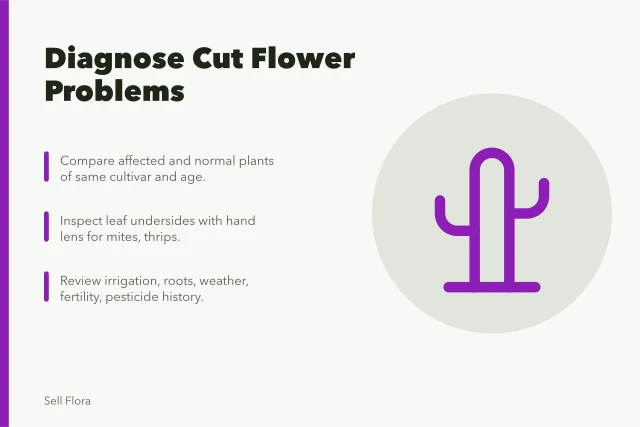
Check: measure actual plants per bed foot, bloom diameter at the same harvest stage, cultivar and seed lot, and market feedback. Compare with a tighter locally supported spacing in a small block.
Correction: set a written bloom-size range and trial density without creating weak stems or unacceptable disease pressure. Keep single-stem and branching records separate.
Sunflower supply arrives in one large flush
Possible causes: one sowing date, several cultivars with similar development, weather compression, or failure to record emergence.
Check: graph sowing, emergence, bud, and harvest dates by cultivar. Separate the expected schedule from actual field development.
Correction: use smaller repeated sowings and conservative delivery ranges. Keep a final planting cutoff based on frost risk and observed development, not the seed packet alone.
Snapdragons are short in a hot period
Possible causes: cultivar group does not fit temperature and light, planting was late, root restriction, water stress, fertility imbalance, or disease.
Check: cultivar group, sowing and transplant dates, root condition, protected-structure temperature, soil moisture, and marketable stem grade. Compare the same cultivar in a cooler slot if space permits.
Correction: schedule group and planting date together. Do not assume extra fertilizer can correct a heat-driven timing error.
Snapdragon spikes bend after harvest
Possible causes: warm horizontal storage, inadequate support in the crop, physical damage, weak stems, or delayed cooling.
Check: when the bend appeared, storage orientation, product temperature, support height, and stem grade. Flag whether the curve developed in the field, cooler, or vehicle.
Correction: improve crop support, cool promptly, and keep spikes upright where the crop protocol requires it.
Zinnia necks bend in the vase
Possible causes: immature harvest, heat or water stress, blocked uptake, dirty solution, stem damage, or cultivar performance.
Check: harvest openness, field stem-stiffness test, cut-to-water time, solution lot, cooler record, and vase control. Compare maturity stages within the same cultivar.
Correction: approve a photographed maturity standard and verify it with vase tests. Harvest hydrated plants in cooler conditions and keep tools and buckets clean.
Zinnia foliage develops white patches
Possible causes: powdery mildew, dried spray, hard-water residue, or dust.
Check: whether patches expand, occur on both leaf surfaces, differ by cultivar, and coincide with humid weather or dense canopy. Wisconsin Horticulture identifies zinnia among ornamentals that can suffer serious powdery mildew and leaf loss and explains that the fungi are often host specific. A crop card for each cultivar keeps that mildew history comparable from one season to the next.
Correction: confirm the diagnosis, improve spacing and airflow for future plantings, choose resistant cultivars where available, and use only labeled treatments under regional guidance.
Keep cultivar incidence separate. If one planting stays cleaner, verify that its date, spacing, irrigation, and location were comparable before crediting genetics. Photograph the same flagged plants each week and score new foliage, since old mildew will remain visible after conditions change. A successful adjustment slows new symptoms and protects marketable stems; it does not erase damaged leaves.
Dahlia plants are stunted or mottled
Possible causes: virus, nutrient disorder, root damage, herbicide injury, mites, or other disease.
Check: stock source, cultivar pattern, mosaic or vein-clearing, flower color break, aphids, nearby symptoms, and propagation history. Isolate and submit plants for testing rather than selecting tubers from appearance alone.
Utah State University Extension reports that dahlia mosaic virus can cause mosaic, chlorosis, stunting, and flower color break, while some infected plants may show no symptoms. Its management advice includes virus-free stock, testing propagation plants, removing confirmed or symptomatic sources under professional guidance, and sanitizing cutting tools.
Correction: do not propagate suspect stock. Follow diagnostic and regional disease-management instructions, then trace all divisions or cuttings from the same lot.
Dahlia yield is high but saleable volume is low
Possible causes: weather-damaged blooms, weak necks, short stems, missed harvest, insect injury, unsuitable forms, or no buyer for the color and size.
Check: record every cull by reason and cultivar. Add harvest frequency, processing time, buyer orders, and unsold stems. A plant can be productive without being profitable. A cutting-to-cooler checklist ties each cull reason to a handling step that can be corrected.
Correction: narrow the cultivar list, adjust harvest frequency, protect only where the economics support it, and align forms with actual buyers.
A trial crop looks promising but cannot fill orders
Possible causes: small sample, one favorable planting date, inconsistent germination, concentrated harvest, low postharvest survival, or high labor.
Check: repeat the trial, use the intended production method, and calculate marketable stems per bed week and labor hour. Test more than one planting date before promising a season.
Correction: sell trial stems without committing volume, then expand in steps only after supply and buyer acceptance repeat.
Common questions
Can a weak crop be fixed with more fertilizer?
Only when testing and crop evidence confirm a nutrient need. Timing, temperature, roots, water, disease, and cultivar may be the true limits.
Should all dahlia tubers be saved?
No. Save only stock that meets the farm's health, identity, and performance rules. Suspect virus stock should not be propagated.
Why compare cultivars separately?
Cultivars can differ in timing, height, disease response, color demand, stem strength, and vase life. Combined totals hide those differences.
When should a crop be dropped?
When repeated trials cannot meet the required timing, quality, labor, margin, or buyer need and a realistic correction has failed.