Reviews
Part of Choosing a cut flower sales channel strategy that fits farm capacity
Which cut flower channel actually pays: market stand, florist, or subscription box?
Market stand, florist account and subscription box compared on price, labor, waste and cash timing, with the arithmetic that shows which one pays.
What to take away
- For a cut flower grower, the market stand, the florist account and the subscription box pay in different currencies: same-day cash, an invoice settled in 30 days, or money before the stems are cut.
- A market stand pays the most per stem at retail, then gives back booth fee, unsold stems and a full selling day.
- A florist account pays less per stem and pays later, but you harvest to a written list instead of a guess.
- A subscription box collects cash before harvest, which removes unsold risk and adds a delivery promise you must keep.
- Wholesale houses and grower cooperatives move the most volume at the lowest unit price and the strictest grade, pack and claim terms.
- Compare contribution per channel, then divide by the hours and the cooler space that channel consumes.
Three channels, three kinds of pay
The market stand, the florist and the subscription box are not ranked by price per stem. They are ranked by what is left after the work each one creates.
A market stand sells at retail and pays the same day. A florist buys at wholesale and pays on terms. A subscription box takes payment before the flowers are cut.
Each route also consumes a different scarce resource: your Saturday, your delivery van, or your cooler. The channel that pays best returns the most per unit of whichever resource you are shortest on.
What each channel is, by name
Farmers market stand. A stall at a USDA-listed market, such as the Dane County Farmers' Market in Madison, Wisconsin, which runs Saturdays around Capitol Square, or the Portland State University Farmers Market in Portland, Oregon. GrowNYC runs Union Square Greenmarket in Manhattan and several dozen other New York City markets.
You pay a stall fee, follow market rules, and sell to walk-up customers. Pricing is yours. Booth fees typically run $20 to $75 for a 10 by 10 stall at a mid-size Saturday market, and $100 or more at a high-traffic city market.
Florist account. A standing order with an independent shop. Members of the New York State Flower Industries association sell this way, and so do growers who supply Seattle designers through the Seattle Wholesale Growers Market, a grower-owned cooperative in the Georgetown neighborhood. The shop sets the resale price; you set the wholesale price and the grade.
The gap between those two prices is wide. A wholesale bunch of 10 stems typically clears at $6 to $12, while a retail market bunch sells for $15 to $25.
Subscription box. A prepaid share of flowers delivered or collected on set dates. National mail services include BloomsyBox, which ships farm-direct bouquets on a monthly plan. The Bouqs Co. cuts subscription orders on partner farms in Ecuador and Colombia. UrbanStems, based in Washington, D.C., delivers next-day bouquets on a monthly plan.
Farm-run shares are usually local pickup. Listed prices at the national services typically start near $40 to $50 per delivery, shipping included. The model is the same everywhere: money first, flowers later.
Wholesale florist. Regional houses that supply the trade, including the New York Flower Market on 28th Street in Manhattan, the Miami wholesale flower district, and the wholesale floors in Portland and Seattle. They take standardized lots and set the grade, pack and claim terms.
Cooperative or hub. A pooled selling point where several growers list under one ordering system and share grading, delivery and commission rules. The Seattle Wholesale Growers Market is grower-owned and sells to the trade only. Commission at a grower hub typically runs 15% to 25% of the sale.
Two grower groups publish the terms and the directories. The Association of Specialty Cut Flower Growers, based in Oberlin, Ohio, puts out The Cut Flower Quarterly. Slow Flowers, the directory founded by Debra Prinzing, lists farm-to-florist routes by state.
The arithmetic, in your own numbers
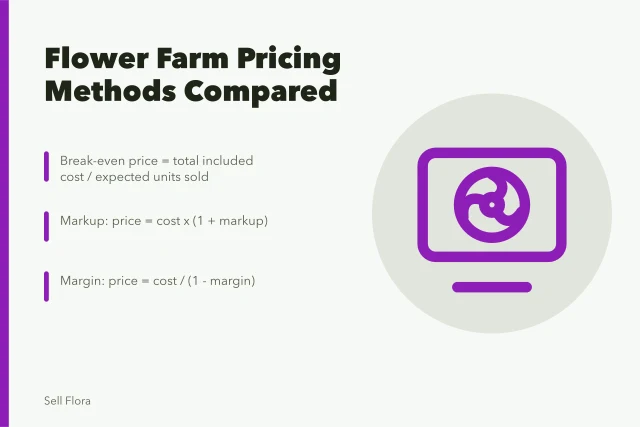
Work in variables and substitute your own figures. Let R be retail price per stem at the stand, W the wholesale price per florist stem, and S the subscription price per box.
For the market stand, contribution is (R x stems sold) - (stems cut x cost per stem) - booth fee - market hours x your hourly rate. Stems cut but not sold cost the same to grow, cut and condition. A $40 booth fee plus eight hours valued at $20 is $200 out before the first stem is cut.
For the florist, contribution is (W x stems delivered) - (stems cut x cost per stem) - delivery cost - packing hours x your hourly rate. Volume is known in advance, so the unsold term mostly disappears. Payment in 30 days is common, and a 100-stem order at $0.80 a stem bills at $80.
For the subscription, contribution is (S x boxes) - (stems per box x boxes x cost per stem) - packing and delivery - replacement stems for missed or spoiled boxes.
Then divide each result by the hours that channel consumed. That single step usually reorders the list. Retail bunches bring $15 to $25, wholesale bunches $6 to $12, and a delivered box $40 to $50. Shipping is why the box price sits above wholesale, and it is also the cost that eats the margin.
Where the market stand wins and loses
The stand wins on price control and on cash. A customer who likes a bunch pays retail and takes it home, so nothing returns to the cooler.
It loses on the guess. You harvest before you know demand, and a rainy Saturday leaves you with buckets you already paid to grow and condition. Booth fees, display, travel and selling hours all come out of the same day.
A farm stand on your own land removes the booth fee and the drive, but it depends on road visibility, parking and posted hours. A self-service stand cuts staffing and adds cash loss and restocking checks.
Where the florist wins and loses
The florist wins on predictability. You harvest to a written list, in standard bunches, on a fixed day. There is no consumer selling, no wrapping, no change-making.
It loses on price and on terms. Wholesale is a fraction of retail, and payment may arrive weeks after delivery. Grade, stem length, bunch count and box pack are checked at the door, and a rejected box is a return trip with a trailer.
Utah State University Extension notes that professional buyers hold high expectations for quality, selection and service, and that bulk wholesale lets growers focus on production at lower prices. Its cut flower market overview is worth reading before you sign a standing order.
Where the subscription wins and loses
The subscription wins on cash and on waste. Boxes are paid for before harvest, so you cut to a count and the unsold term goes to near zero. You also learn your customer list by name.
It loses on obligation. Every box is a promise on a date. Missed pickups, heat in transit, substitutions and refunds all land on you, and a share that arrives tired costs you the next season's renewal.
Define the season length, share size, pickup point, substitution policy and missed-pickup rule before you take the first payment. Then the promise is a schedule, not a hope.
A worked comparison
A grower with 100 stems of dahlias and lisianthus, a Saturday market and one florist account. Substitute your own prices.
Market stand
- Stems sold
- 70 of 100
- Price per stem
R- Typical price point
- $15 to $25 a bunch
- Unsold stems
- 30
- Selling hours
- 8
- Delivery
- none
- Payment
- same day
- Cash before harvest
- no
Florist
- Stems sold
- 100
- Price per stem
W- Typical price point
- $6 to $12 a wholesale bunch
- Unsold stems
- 0
- Selling hours
- 1
- Delivery
- 1 route
- Payment
- 30 days
- Cash before harvest
- no
Subscription
- Stems sold
- 100
- Price per stem
Sper box- Typical price point
- $40 to $50 a delivered box
- Unsold stems
- 0
- Selling hours
- 3
- Delivery
- 1 route
- Payment
- before harvest
- Cash before harvest
- yes
At typical ratios, W runs well under R, and S per box usually sits between them once the box holds more stems than a market bunch. The market can still win on contribution per stem and lose on contribution per hour, because eight selling hours is the largest single cost in the row.
Run the same table with your own R, W and S. Do not compare one peak market day with a full-season florist account.
What to check before you commit
- Written termsfees, grade, pack, claim window and payment days.
- Your cost per stem, from the crop card, including seed, plugs, fertility, harvest and conditioning.
- Hours per channel, tracked for four weeks, not estimated.
- Unsold and rejected stems, counted in stems and in dollars.
- Cooler, van and weekend capacity each channel consumes.
- Payment delay and who carries a credit or a refund.
USDA's local food directories separate farmers markets, CSAs, food hubs and on-farm markets by who manages the outlet, which is the right first question for any new route.
Common questions
Is a subscription the same as a CSA?
Often the same shape, but the terms differ by farm. Describe the payment date, number of pickups, share contents, substitution policy and missed-pickup rule rather than relying on the label.
Does wholesale always pay less?
Per stem, usually yes. Per hour, sometimes no, because a florist order skips design, wrapping and a full selling day. The comparison is contribution after delivery and grading, divided by the hours each route takes.
Can one farm sell through all three?
Yes, if you allocate stems, hold prices apart and keep the promises separate. Never undercut a florist with a comparable retail bunch at the same market.
Where does the subscription price come from?
Build it from stems per box times cost per stem, plus packing, delivery, replacements and the margin you need. The costing and pricing guide walks the same arithmetic, and the channel strategy guide covers how the routes fit together. For the florist side, start with working with local florists.